STORIES 250

Anne Frank had an Iowa Pen Pal Before WWII
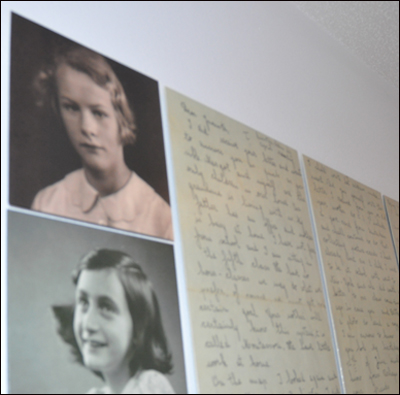
Author’s Note: In 2014, a teacher suggested I visit a small museum in Danville, Iowa, that was dedicated to Anne Frank. To my surprise, I learned that Anne Frank and her sister, Margot, had pen pals in Danville. The four girls only exchanged a couple of letters before Nazi Germany invaded Holland in May 1940. The Iowa sisters learned after the war they had been pen pals with Anne and Margot. The following is my 2014 article, edited for updates. 

Featured image above: At the Danville Museum in Danville, Iowa, Juanita Wagner, top, and Anne Frank, below, are pictured next to a copy of the letter Anne sent to Juanita in April 1940. (Photo: Redwood Educational Technologies)

Article:

Girlfriends, sisters, and students today are no different from girlfriends, sisters, and students of 75 years ago. Take a moment to learn the story of Anne Frank, a Holocaust victim, who briefly exchanged letters in 1940 with Juanita Wagner, a Danville, Iowa student. Margot Frank, Anne’s sister, exchanged letters with Betty, Juanita’s older sister.

Miss Birdie Mathews, Danville, Iowa teacher and world traveler
In 1939, Miss Birdie Mathews, a Danville, Iowa teacher, began her ‘international correspondence’ program with her students based on her many travels to Europe and her coursework at Columbia University in New York City.

Miss Birdie Mathews, a teacher in Danville, Iowa, began an ‘international correspondence’ program with her students for 1939 to 1940 school year. (Photo: Redwood Educational Technologies)

An innovative and energetic teacher, Miss Birdie traveled so she could bring back a snapshot of those faraway worlds to her students. Her first trip to Europe was in summer 1914 as World War I erupted after the assassination of Archduke Ferdinand of Austria and Sophie, his wife, in Sarajevo.

Miss Birdie Mathews, a teacher in Danville, Iowa, began an ‘international correspondence’ program with her students in 1939-1940. (PHOTO)

World War II and Miss Birdie’s Pen Pal Project
Twenty-five years later Adolf Hitler, Germany’s pugnacious dictator, was marching through Europe on a quest for world domination. On Sept. 1, 1939, Hitler’s Germany invaded Poland. Tensions had been building for many years but now it was official – World War II had begun.

In Iowa, Miss Birdie was ready for the 1939-1940 school year. She compiled a list of names of students in Europe with whom her middle school students could correspond. The project kicked off in January 1940. Juanita decided she would choose a student from Holland. From the list of 26 names, Juanita chose a girl living in Amsterdam – Anne Frank. Betty, Juanita’s older sister, chose Margot Frank.

Letters from Anne and Margot Frank to Betty and Juanita Wagner, Iowa students
On March 5, 1940, the Danville school newspaper reported that Juanita had received a reply from Europe. Then in a letter from Anne to Juanita dated April 29, 1940, Anne enclosed a second letter from Margot, her older sister. That letter was written to Betty. Two sets of sisters, separated by a vast ocean, were helping each other learn about their lives and culture. In Anne’s April letter to Juanita, she also enclosed a postcard showing the canals in Amsterdam. Anne told Juanita she collected postcards and had about 800 in her collection.

Juanita and Betty answered the April 1940 letters from Anne and Margot immediately. They enclosed their pictures as Anne had requested. Juanita and Betty never heard from Anne and Margot again.

Otto and Edith Frank, Anne and Margot’s parents, moved the family to Amsterdam from Germany in 1937 after Hitler came to power in the 1930s. Otto thought Amsterdam would be a safe place for his family to live while tensions were high in Germany.

Nazi Germany invades Holland in 1940
Just three weeks before Anne wrote her April 1940 letter to Juanita, Nazi Germany invaded Denmark and Norway. On May 10, 1940, Germany invaded the Netherlands (Holland). Life became very difficult for the Frank family and all Jewish families living in Amsterdam.

Over time, harsh rules were placed on what Jewish families could and could not do. They were no longer allowed to attend movies so Otto rented a projector and films to show at home. Anne and her friends often went out for ice cream but soon had only a couple of ice cream parlors that would serve Jewish families.

Anne attended a Montessori school in Amsterdam where her teacher had agreed to have her students correspond with Miss Birdie’s students during the 1939-1940 school year. Hannah Goslar was Anne’s best friend at school. But the end of that year brought sad news for Anne and Hannah.

For the 1940-1941 school year, Anne and Hannah were no longer allowed to attend their Montessori school. They had to attend an all Jewish school. Anne immediately found a friend at her new school – Jacqueline (Jacque) van Maarsen. Anne, Hannah and Jacque asked two other girlfriends – Ilse Wagner and Susanne (Sanne) Ledermann – to start a club. The Little Dipper Minus Two Club was born. The girls thought the Little Dipper constellation had five stars, one for each friend, but when they learned the Little Dipper had seven stars, they just added “Minus Two” to the name of their club.

The Little Dipper Minus Two Club elected officers; played Ping-Pong and Monopoly; and read books together. They especially liked a series of books about the adventures of Joop, a teenage girl, by Cissy van Marxveldt. Joop kept a diary.

The Frank Family goes into hiding – 1942
On June 12, 1942, Anne celebrated her 13th birthday. She had picked out a red and white plaid diary that she received as a present. On July 6, 1942, the Frank family went into hiding when Margot, who was now 16 years old, was “called up” by the Nazis to work. Otto knew the family would be forced into hiding one day so he had prepared an apartment over his office where they could live.

The time in hiding was very difficult for Anne who was an energetic and gregarious girl. She could not make any noise during the day and could never go outside. Anne spent more and more time writing in her diary. She dreamed of going to Hollywood to be a writer. The family would live in hiding for 25 months.

The Frank Family is found and sent to concentration camps – 1944
On August 4, 1944 just two months after the Allied D-Day invasion in France, Anne and her family were discovered by German secret police, the Gestapo. The family was sent to concentration camps. Anne and Margot were separated from their parents at Auschwitz in Poland and never saw them again.

In October 1944, Anne and Margot were sent to Bergen-Belsen in northwest Germany. In mid to late March 1945, Anne and Margot both died of illness, most likely typhus that was rampant in the camp. They died just a few weeks before Bergen-Belsen was liberated. Edith Frank died at Auschwitz in early 1945. Only Otto survived the Holocaust and returned to Amsterdam.

Ilse and Susanne, Anne’s friends and fellow Little Dipper Minus Two Club members, were both gassed to death in a concentration camp on the day they arrived at the camp. Hannah survived the Bergen-Belsen camp where she saw Anne before they died. Jacque was never sent away.

During the war, while many reports of Jews being sent to camps were known in America, the scale and horror of Jews being murdered at death camps in very large numbers was not. The United States had entered World War II after Japan attacked Pearl Harbor, a U.S. Navy Base in Hawaii, on Dec. 7, 1941.

After World War II – 1945
Juanita and Betty Wagner never forgot Anne and Margot. Just after the war in 1945, Betty sent a letter to them at the same address in Amsterdam. In a long reply she received a few months later, Otto Frank told her the tragic story. Betty cried when she read the letter.

In 1956 and now living in California, Betty was driving home from work when she heard on the radio about a hit play on Broadway called The Diary of Anne Frank. Could this be the same Anne Frank who was her sister’s pen pal 16 years ago? It was. Anne’s diary had first been published in Dutch in 1947 under the title, The Secret Annex. It was first published in English in 1952 under the title, Anne Frank: The Diary of a Young Girl.

For 48 years, Betty privately kept the two letters from Anne and Margot. In 1988, the letters were purchased at auction for $165,000. The buyer then donated the letters to the Simon Wiesenthal Museum of Tolerance in California.

Janet Hesler of Danville is helping new generations of students learn about the horrors of the Holocaust so it is not repeated. She is the curator of a small Danville museum where she tells visitors and students the story of Anne, Margot and the Wagner sisters.

Janet Hesler tells the story of Anne Frank and the Wagner sisters at the Danville Museum on Jan. 23, 2014. (Photo: Redwood Educational Technologies)

After a tour of the museum, Janet quietly ended her presentation with a footnote explaining her personal connection to the Holocaust. With tears welling in her eyes, she said her father was part of the military contingent that arrived at the Dachau concentration camp in Germany one day after it was liberated.

When the night sky is clear, look up at the Little Dipper with its seven twinkling stars. Think of Anne and the Little Dipper Minus Two Club. Then tell the story of Anne, Margot, Hannah, Susanne, Jacqueline, Ilse, Juanita, and Betty – sisters, girlfriends, students – to a friend or neighbor so it is never forgotten.

For more information, read: Searching for Anne Frank: Letters from Amsterdam to Iowa by Susan Goldman Rubin, published in 2003.

Exit mobile version