STORIES 250

The Wright Brothers Had Their Minds in the Sky, Not Their Heads in the Clouds
Author’s Note: Since the 2003 Centennial of Flight celebration, I have written many stories on the Wright brothers. In Dayton, many locations honor the brothers, their family, and friends. One of my favorite visits was to the Wright B Flyer Museum where volunteers built an operable Wright B Flyer. Watch the video below of its chief pilot and the airplane in flight.

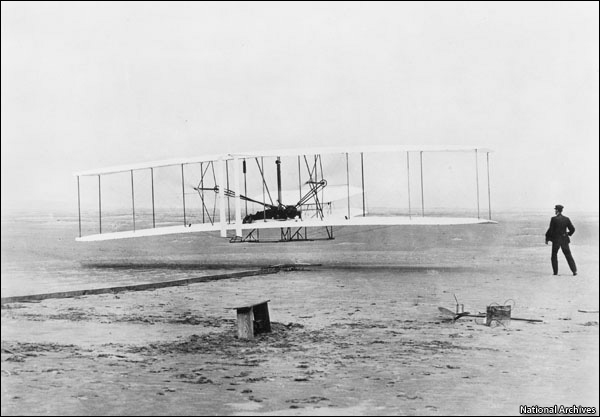
Featured image above: This is the iconic photo taken on Dec. 17, 1903 in North Carolina when the Wright brothers conquered human flight. (Photo: National Archives)

STORY

Sept. 19, 2016 – David McCullough, author of the 2015 best selling book, The Wright Brothers, was awarded the 2016 Combs Gates Award by the National Aviation Hall of Fame (NAHF).

More than 100 years after men and motor became airborne, the invention of the airplane can still prompt spirited discussions, especially among residents of North Carolina and Ohio.
Wright brothers first flight came after years of experience and study

On Dec. 17, 1903, Orville and Wilbur Wright, brothers from Dayton, Ohio, maintained altitude in a heavier-than-air machine they controlled. Over the skies of Kitty Hawk, North Carolina that day, they made history. They chose that location because of sandy beaches and favorable winds. But they designed and built their first gliders and airplanes in Dayton, Ohio where they were born and raised. They owned and operated the Wright Cycle Company, a bicycle company.

In McCullough’s book, readers learn of the tremendous amount of time Orville and Wilbur spent studying birds to learn about aerodynamics and wing design. The brothers kept meticulous notes. They were so dedicated to their goal, neither one married.

Their mechanical aptitude was evident as young boys. They took apart toys. They were encouraged by their mother who was mechanically inclined. She built a sled for her children and fixed their toys and whatever was broken in the household.

Orville graduated from high school but Wilbur did not due to an injury. As they grew, the brothers delved into any aviation book they could find. They became self-taught aeronautical engineers and aviation experts.

Bicycles became a popular mode of transportation in the late 1800s. The brothers began repairing and improving bicycles. They made bicycles safer with a new brake design. In 1895, their company began selling its own bicycle. Called the Van Cleve, it was named after their great-great-grandmother (The Wright Brothers, p. 25).

The Wright brothers designed and sold their Van Cleve bicycle. This photo was taken at the brothers’ workshop, which is part of the National Park Service Dayton Aviation Heritage Area and is located next to the park’s Visitor Center in Dayton, Ohio. (Photo: Redwood Educational Technologies)

Orville loved to ride his bike. The thrill of becoming airborne while riding could only be topped by being able to remain airborne.

In 1896 after Orville recovered from typhoid fever, the brothers began reading books and papers about aeronautics. They were influenced by Otto Lilienthal, a German mining engineer who studied birds to understand how to glide in the air. Otto believed birds held the clue to how man could sustain flight. Gas balloons did not resemble birds’ wings so Otto designed his contraptions to look like birds. (The Wright Brothers, p. 28).

Orville and Wilbur first built gliders. Once satisfied with their glider, they began building a motor to defy gravity. They adapted bicycle parts. The end result was a flying machine. It was based on their deep knowledge of physics and aeronautics and their years of experience repairing and building bicycles.

In the early 1900s, they were ready to test their flying machine. Versions of their gliders and flying machine had already been tested in North Carolina.

On Dec.17, 1903, the brothers, with five other people watching, successfully flew for 12 seconds for a distance of 120 feet. John T. Daniels snapped the picture that is now one of the most famous photos ever taken. The brothers took turns flying that morning and by noon, they had logged a flight of 59 seconds at an altitude of 852 feet and a distance of more than one-half mile (The Wright Brothers, p. 105-106). Human flight had been conquered.

North Carolina and Ohio claim first flight honors
A friendly spat between North Carolina and Ohio has surfaced periodically. The first flight no doubt took place in North Carolina. But the airplane was made in Ohio. Both states are proud of their aviation history.

2016 Rio Olympics and mention of the Wright brothers
At the 2016 Rio Olympics, many North Carolina and Ohio residents bristled during the opening ceremony when Brazil took credit for the first flight. Television commentators explained that Brazil did not believe the Wright brothers were the first because there was no record of their first flight. Surely the commentators would reference the Dec. 17, 1903 photo taken but they did not. They said it was Brazil’s night to shine so let it be. The debate moved quickly to social media.

Read David McCullough’s book. It sets the record straight and is a gift to aviation and American history. Orville and Wilbur had their minds in the sky, not their heads in a cloud. Readers will have a new or a renewed respect for their total dedication to understanding aeronautics and conquering human flight. Two other books about the Wright brothers are also excellent: Kill Devil Hill by Harry B. Combs with Martin Caidin (1979) and The Bishop’s Boys: A Life of Wilbur and Orville Wright by Tom D. Crouch (1989 and 2003).

Early aviation pioneers surely learned from each other but it was the Wright brothers who figured out how to build an airplane. They filed many patents to protect their design. Sadly, Wilbur spent a lot of his time defending those patents so others could not profit from their years of work. By 1912, Wilbur was worn down from all of the travel. He became ill with typhoid fever and died on May 30, 1912. He was 45. Orville was devastated. He operated their airplane manufacturing company for a few years but sold it by 1918 (The Wright Brothers, p. 258-259). After selling the company, Orville opened the Wright Aeronautical Laboratory in downtown Dayton where he conducted research – and made toys.

Orville died on Jan. 30, 1948 having lived to see the airplane rapidly evolve for commercial and military uses. He was one of the founding members of the National Advisory Committee for Aeronautics (NACA), the organization that would become NASA.
On the page before the Table of Contents in The Wright Brothers, McCullough quotes Wilbur Wright as follows: “No bird soars in a calm.”

The brothers had lives filled with adventure and years of studying, designing, building, testing, taking risks, and persevering to finally join the birds flying in the sky!

Exit mobile version