Author’s Note: On Dec. 11, 2015, I traveled to the Maltz Museum of Jewish Heritage near Cleveland, Ohio to visit their exhibit: Violins of Hope. The article below is from that visit with edits to update.
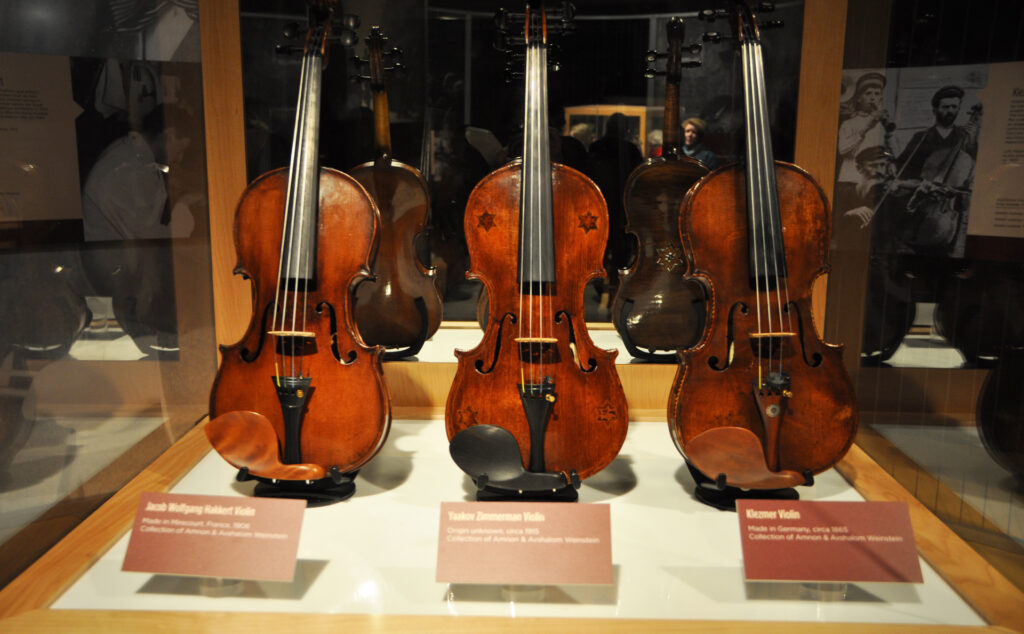
Featured image above: In the center, Amnon Weinstein’s “Auschwitz” violin is on display, one of 19 violins in the Violins of Hope exhibit at the Maltz Museum of Jewish Heritage near Cleveland, Ohio. (Photo: Redwood Educational Technologies)
Article
The sense one has entering the Violins of Hope exhibit at the Maltz Museum of Jewish Heritage near Cleveland, Ohio is one of profound sorrow. Nineteen violins, many played by Holocaust victims in their darkest hours, rest silently in display cases. The violins were repaired and restored by Amnon Weinstein, second generation master violin-maker who lost 400 members of his family during the Holocaust. Silent for many years, the violins now speak for millions.
Amnon Weinstein
The long corridor and first display at the exhibit’s entrance were designed to herald the powerful story about to unfold in the exhibit, according to Jeffery Allen, director of education and public programs at the museum.
At the end of the corridor there is one violin, taken apart to show its parts, in a case in front of a video screen. The display case creates a natural stop for visitors. Through a short video, Amnon introduces the exhibit from his violin workshop in Tel Aviv, Israel. His story is sorrowful yet uplifting.
The entrance to the Violins of Hope exhibit at the Maltz Museum of Jewish Heritage (Photo: SNN)
Violins of Hope began many years ago when an old violin played during the Holocaust was brought to Amnon for repair. He opened it and found ashes inside, presumably from a concentration camp where the violin was played near a gas chamber and cremation site. It was the start of Amnon’s work to restore Holocaust-era violins to give voice to voices long ago silenced. Some of those voices were his own family members.
Amnon’s immediate family left Europe in 1939 to settle in Palestine where his father continued his work as a violin maker. But 400 family members in Europe perished. His family never spoke of the horror. Amnon decided music, through violins he would repair, would speak for his family and six million Jews, including 1.5 million children, who were murdered during the Holocaust.
Over the past 25 years, Amnon has collected and repaired more than 45 Holocaust-era violins from around the world. Some of the instruments were made in the 18th century but the value of the instruments is not because of age. It’s the history of the people who played the violins and where they played them – in labor camps, ghettos, and concentration camps hidden from the world by Adolf Hitler and his Nazi oppressors.
Violins have always played a major role in Jewish culture. Note the Star of David engraved in the wood on this folk violin that was played at Jewish celebrations. Note the Star of David on the back of the violin from the reflection in the glass. (Photo: SNN)
After being repaired, the violins have been played by professional violinists and orchestras around the world at Violins of Hope concerts.
“When my violins are on stage, six million people are standing behind them,” Amnon said in a Maltz Museum press release.
Violins of Hope exhibit – curated and developed by the Maltz Museum of Jewish Heritage
The Cleveland exhibit is only the second time some of Amnon’s violins have been in the United States.
When a Violins of Hope concert was being planned by The Cleveland Orchestra to dedicate the 2015 opening of the newly renovated Silver Hall on the campus of Case Western Reserve University, the Maltz Museum suggested an exhibit to accompany the concert.
Samantha Fryberger, director of marketing and communications at the museum, said seven organizations and more than 50 funders immediately offered to partner with the museum. Meetings were held, tasks were assigned, and the exhibit came to fruition. It opened at the museum on Oct. 2, 2015.
The exhibit emphasizes the diverse experiences of Jewish violinists during the Holocaust and the power of the music they played.
Music, normally an uplifting universal language, had never been used in the commission of genocide. It’s a juxtaposition that is difficult to fathom.
Music saved some Jewish violinists from death but not others. Music was used as a tool of oppression as Jewish prisoners were forced to play as other prisoners arrived at the camps and were then killed. It was used as a form of protest when Jewish prisoners defied rules by hiding their instruments and secretly playing them. Music was also a source of hope for prisoners who said they were transported to a better world while playing their violin even if it was just for a few minutes.
“We played music for sheer survival. We made music in hell,” Heinz ‘Coco’ Schumann, a famous German jazz musician who survived the Holocaust, said as noted by an inscription on one wall of the exhibit.
Designed with dramatic lighting and circular pods constructed with string to evoke the violin, the exhibit’s five sections are organized chronologically from before World War II to the liberation of concentration camps in 1945 at the end of World War II.
Second pod
In the second pod, called Discordant Notes: The Rise of Anti-Semitism, visitors are startled looking at the case holding a violin with a swastika drawn on the inside. The violin was brought to Amnon for repair. Upon opening the violin, he saw the inscription: “Heil Hitler 1936” and the swastika. Amnon surmises a Jewish citizen took the violin for repair as Adolf Hitler was rising to power in Germany in the 1930s. The angry violin maker decided to secretly pay homage to Adolf Hitler and have the Jewish person play the violin without any knowledge of what he wrote. Amnon refused to repair the violin, one of only two violins he would not repair.
Third pod
In the third pod, called Cacophony in Captivity: Ghettos and Labor Camps, Jeffery pointed out a photo of Feivel Wininger (far right in photo below), a young man holding his violin.
After being forced to leave his home and live in a ghetto, he survived the Holocaust by earning money for his family from playing his violin. After the Holocaust, his family wanted to buy him a new violin but he would not part with the instrument he called his friend that saved him and his family.
The exhibit also includes a photo of Feivel (see below) at age 90 holding the same violin with the same smile he had as a young man.
Fifth pod
The fifth pod, called Measures of Defiance: Jewish Resistance, includes a 1944 video that appears to be depicting a happy event of people attending a concert at Theresienstadt, a camp-ghetto. Newly composed music is being played by an orchestra while the audience, dressed in their finest, is seated at tables decorated with flower centerpieces.
However, the film was really Nazi propaganda produced after they fooled Red Cross officials who were investigating reports of genocide at labor camps.
The entire event was staged to hide the real conditions people in the audience faced. A note at the exhibit states that before the concert, 7,500 elderly and frail prisoners were sent to Auschwitz. And after the Red Cross visit, nearly 20,000 people who were in the film were sent to Auschwitz. Looking at the film a second time with that information, the horror can be seen in prisoners’ eyes, a window into the human soul.
Music to heal the world
More than 70 years after the Holocaust, the world is still learning about its horrors. As the violins from the Holocaust continue to play in concert halls around the world, could the power of music be harnessed to foster peace and tolerance so innocent voices are never silenced again?
For more information on Amnon and Violins of Hope, visit Violins of Hope.