

Sept. 23, 2020 – The fourth Saturday in September is National Public Lands Day. Many admission fees are waived at national parks and other public lands so it’s the perfect day to escape from COVID-19 life. Explore wide open spaces where it is easy to practice social distancing.
Redwood Learn visited Lassen Volcanic National Park in northern California in 2015. We took a hike that passed through boiling mudpots, fumaroles, and other amazing geologic features. The park celebrated its Centennial in 2016. Imagine exploring the park in 1916!
The park was intriguing just from scrolling through Lassen’s website. Pictures of boiling mudpots and fumaroles are strange but interesting. As soon as the park description mentioned that all four types of volcanoes are found in the park, it was a location Redwood Learn had to visit!

(Photo: Redwood Learn)
History
During the Gold Rush in the 1840s and 1850s, large numbers of people migrated westward to find their fortunes. In 1864, Kendall Bumpass and a friend explored the area. They were thinking about opening a portion of it as a public attraction. Little did they know the steaming mud pots and fumaroles around them were among the most caustic in the world. Kendall stepped into a boiling mud pot and lost his leg. He had stepped into very hot acid. Plans to open a public attraction ended.
Fumaroles are breaks (fizzures) in the ground through which steam and sulfur gas (hydrogen sulfide) escape. This geologic feature is the result of hot magma underground combining with water.
The last eruptions of Lassen Peak occurred between 1914 and 1921. The largest explosion occurred on May 22, 1915. Benjamin Loomis, a local businessman, took photos of the 1915 eruption. The park was set up on August 9, 1916. It was days before the U.S. Congress voted to establish the National Park Service.
According to NPS, every rock in the park originated from volcanoes. A hike not to miss is the “Bumpass’ Hell Trail.” It’s named after Kendall Bumpass.
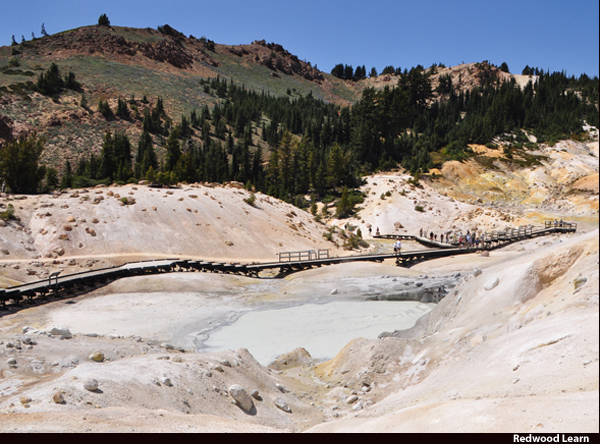
in the air from the fumaroles. (Photo: Redwood Learn)
The hike is a walk through geologic and American history. From the trailhead, hikers walk next to beautiful wildflower meadows, hug the side of mountains at 8,000 feet above sea level and then descend to a hydrothermal basin. The basin looks like the Red Planet – Mars. Fortunately, there is a boardwalk in the basin. It passes over the acidic, boiling mudpots. In 2018, the park closed the boardwalk for renovation. It’s open now but will close soon for the winter.
To find a national park near you, visit the National Park Service (NPS).
To find a national wildlife refuge near you, visit the U.S. Fish and Wildlife Service (FWS).
For an expanded science article with more information on the four types of volcanoes and other learning activities, click here.