

March 5, 2021 – Hidden Figures: The American Dream and the Untold Story of the Black Women Mathematicians who Helped Win the Space Race is a book by Margot Lee Shetterly. She wrote it in 2016. Her book was made into a movie with the same name. It tells the riveting story of Black female ‘human computers’ who were recruited in the 1940s to work at the Langley Aeronautical Laboratory, a lab operated by the National Advisory Committee for Aeronautics (NACA). The lab was in Langley, Virginia.
NACA evolved to NASA in 1958. With the advent of mainframe computers in the late 1940s, ‘human computers’ learned how to program mechanical computers. They remained a vital part of Langley’s workforce. The U.S. was in a space race with the Soviet Union. In 1961, President Kennedy challenged the nation to land a man on the moon before the end of the decade.
Redwood Learn interviewed Bill Barry, NASA’s chief historian, on Feb. 9, 2018 about that important period in NASA history.
NACA history
The Wright Brothers conquered human flight in 1903 with a successful flight on the shores of the Atlantic Ocean in Kitty Hawk, North Carolina. The designed and built their airplane in Dayton, Ohio. They took it to Kitty Hawk, North Carolina because of sand and wind. After they were successful, the rush to innovate flight took off quickly in Europe. By 1915, European developments outpaced the United States. To answer the growing imbalance, the United States formed NACA. Orville Wright was named one of seven committee members. The committee reported directly to the president.
In 1920, the committee established the Langley Aeronautical Laboratory to test airplanes. Begun with 15 employees, by 1925, there were more than 100 employees, according to NASA.
In the 1930s, NACA identified the need to hire ‘human computers’ to literally do the math. Hundreds of calculations needed to be performed from the many tests being conducted, particularly tests in the wind tunnel to determine the best aerodynamic design for airplane wings and other parts.
When World War II erupted in Europe in 1939, Langley’s work accelerated. In the early 1940s, NACA needed many more human computers. They began recruiting African American women, many of whom were math teachers at schools in the Hampton, Virginia area where Langley was located.
Hidden Figures: Dorothy Vaughan, Katherine Johnson, and Mary Jackson
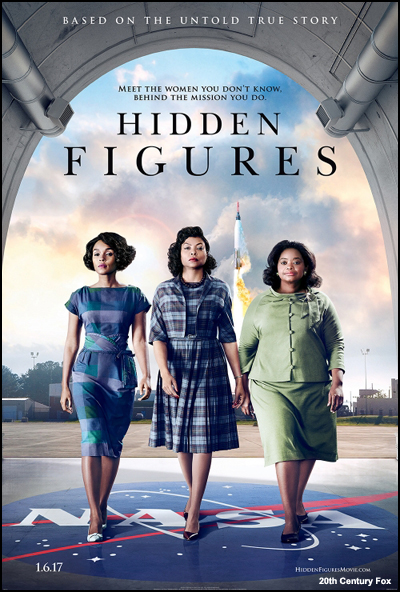
Dorothy Vaughn, one of the three main characters in Hidden Figures, graduated in 1929 with a Bachelor of Arts (B.A.) in mathematics from Wilberforce University near Dayton, Ohio. NACA hired her in 1943 during World War II. In 1949, she was named supervisor of the West Area Computing group, the first African American to lead a group of human computers at Langley. She retired from NASA in 1971.
NACA hired Katherine Johnson in 1953. She was an expert in theoretical mathematics. She was named to the Space Task Group that was responsible for planning trajectories for the early space missions, including John Glenn’s 1962 Friendship 7 mission. During this mission, Glenn became the first American astronaut to orbit the Earth. Katherine retired from NASA in 1986 and turned 100 on August 26, 2018. A building at Langley has been named in her honor. Katherine passed away on Feb. 24, 2020. She was 101.
NACA hired Mary Jackson in 1951. She grew up in Hampton, Virginia and graduated in 1942 from the Hampton Institute with a dual degree in Mathematics and Physical Sciences. At NACA, she worked under Dorothy in the West Area Computing group. Because of her talent, she was encouraged to advance her education in engineering and became an aeronautical engineer. She was most likely the first African American female aeronautical engineer in the United States. NASA just named its headquarters in her honor.
There were about 300 human computers working at Langley in the 1940s and 1950s of which about 50 were African American women. Dorothy, Katherine, and Mary represent the work of all 300 human computers. The three women are the main characters in the Hidden Figures book and movie.
REVIEW QUESTIONS
1. Why was NACA formed?
2. When did the Wright Brothers complete their first successful flight?
3. Where did NACA test airplanes?
4. What were “human computers?”
5. Why were more “human computers” needed in the late 1930s?
6. Who is the focus of the book, Hiddden Figures, by Margot Lee Shetterly?
INQUIRY QUESTIONS
1. How did the women who were hired by NACA in the 1930s and 1940s as “human computers” pave the way for women in aviation today?
2. How did the United States reposnd to the Soviet Union in what became known as the “space race.”
3. What were some of the many challenges the Black human computers faced in the early days of their employment at NACA and NASA?