

Oct. 27, 2020 – Washington State Department of Agriculture, WSDA, entomologists donned protective suits last Saturday to eradicate a nest of Asian giant hornets (Vespa mandarinia). The nest was on private property in Blaine. The hornets are an invasive species that can kill a honeybee hive in hours. Honeybees are pollinators vital to Washington’s apple and blueberry crops. So it is all hands on deck to trap, track and eradicate the hornets. WSDA Hornetbusters are walking in the steps of the famous Ghostbusters!
The nest in Blaine is the first nest found in the United States. Blaine is near the Canadian border. Saturday’s eradication could have easily been a scene from Ghostbusters, the wildly popular 1984 movie. Many kids dressed as a Ghostbuster for Halloween in the 1980s. Guess what is happening this year!
WSDA Video of hornets removed from nest in a tree
WSDA Entomologists – the Hornetbusters
The Asian giant hornet is the largest hornet species in the world. The Hornetbusters bought their protective suits on Amazon, Sven-Erik Spichiger, WSDA entomologist, said during a virtual press conference yesterday. From 20-50 people are killed in Japan annually from giant hornet stings, he added. Inadvertently stepping on a nest in the ground can release hundreds of angry hornets. Multiple stings, each with a large dose of venom, is why the hornet is so dangerous.
Timeline
After spotting the first hornet in December 2019, the WSDA asked citizens to set traps.
In July 2020, the first hornet was trapped. And then they trapped more. Entomologists fed the insects strawberry jam to keep the insects alive. Three trapped hornets were outfitted with radio trackers.
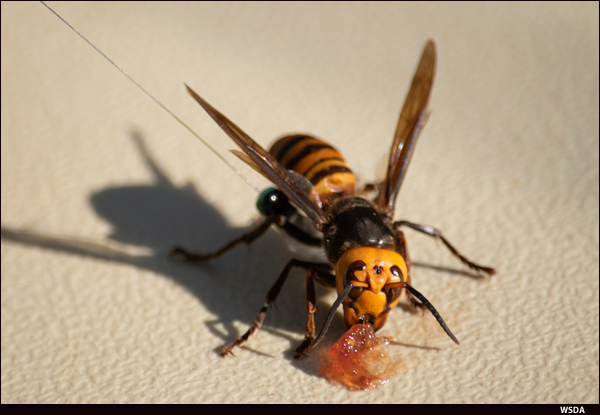
In September, a citizen reported seeing a hornet on his property which led to ultimately finding the nest on another property.
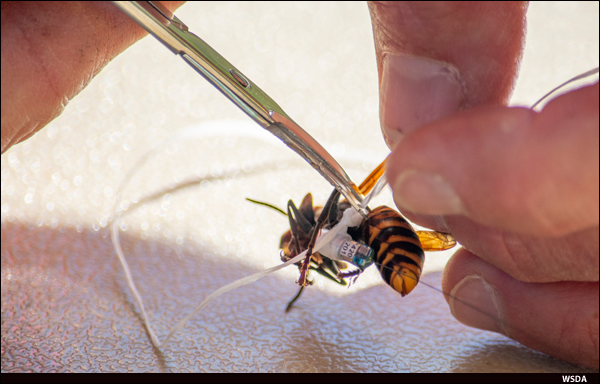
Department of Agriculture (USDA). (Photo: Washington State Dept. of Agriculture)
Sven describes the sinking feeling when they tracked one of the hornets to private property. There was a child’s playset within a short distance of the nest. The nest was in a tree, not in the ground. The location surprised the WSDA team.
Their role as scientists tracking an invasive species quickly changed. They were now Hornetbusters.
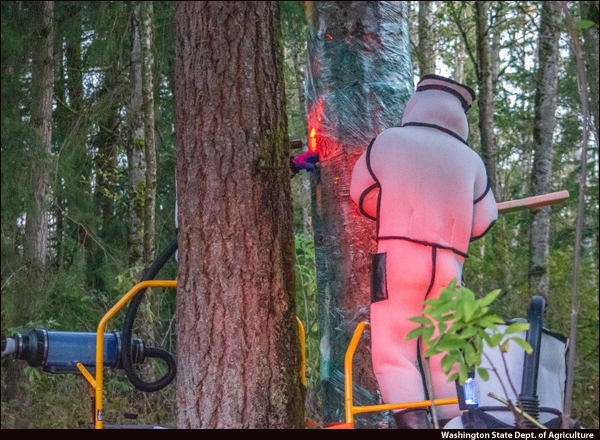
A red light is being used because insects cannot see red light, according to WSDA entomologists. (Photo: WSDA)
Saturday’s operation began before dawn. The WSDA team first set up scaffolding around the tree so they could reach the opening of the nest, which was about 10 feet high. They stuffed dense foam padding into a crevice above and below the nest entrance. They wrapped the tree with cellophane, leaving just a single opening. Sven describes the hornets as docile at first, likely because it was cold. After a whack on the tree with a wooden board, the hornets began flying out of the nest.
The Hornetbusters then inserted a vacuum hose to remove the hornets.
When the hornets stopped coming out of the nest, the team pumped carbon dioxide into the tree to kill or anaesthetize any remaining hornets. They then sealed the tree with spray foam, wrapped it again with cellophane, and finally placed traps nearby to catch any potential survivors or hornets that may have been away during the operation and return to the tree.
“This weekend’s successful operation is due in large part to the careful planning and hard work of our Pest Program team,” WSDA director Derek Sandison said in a press release. “I also want thank the landowners, all those who have reported Asian giant hornet sightings to us, and the citizen scientists who set traps, as well as staff with the U.S. Department of Agriculture, Washington State University, and the University of Washington who have assisted in these efforts.”
They caught 85 hornets Saturday. No team member was injured. Another 13 hornets were caught flying around the tree Friday as they prepared for Saturday.
Next steps
Neither a queen nor the hornet with the tracker were caught, Sven said. This week the tree will be cut down. Since it is wrapped in cellophane, they are hoping to find the remaining hornets and study the nest.
Their work goes on. Sven said they believe there are probably three more nests but since all sightings have been in Whatcom County, they are hopeful they will be able to control and eradicate the hornets.
If anyone is thinking of dressing as a Hornetbuster for Halloween, Amazon is sold out!
REVIEW QUESTIONS
1. Why is the Asian Giant Hornet an invasive species?
2. What are “entomologists?”
3. What does the hornet do to honeybees?
4. What did the Washington State Department of Agriculture ask citizens to do?
5. What did WSDA entomologists do when they found a hornet’s nest in a tree?
INQUIRY QUESTIONS
1. Why is it important to eradicate the hornet species from the state of Washington?
2. Why are WSDA Hornetbusters walking in the steps of Ghostbusters, a popular 1984 movie?