

Jan. 5, 2023 – On a sunny day even in the middle of winter, one can feel the warmth of the Sun, a star that is 93 million miles from Earth. And as the Earth completes one rotation around the Sun every 365 days, the number of hours of daylight in each 24-hour day varies. How does the Sun provide the necessary heat and light to sustain life on Earth?
The answer is found in two chemical elements – hydrogen and helium. On the Sun, hydrogen atoms fuse (join together) to form helium. This chemical reaction, called nuclear fusion, produces massive amounts of energy in the form of heat and light. For many years, scientists have been trying to simulate this reaction to harness that energy.
In December, scientists working at the Lawrence Livermore National Laboratory in California announced a breakthrough in their quest to conduct nuclear fusion reactions on Earth. Their goal is to have hydroigen fusion become a major source of energy. With eight billion people living on Earth, a lot of energy is needed. Will nuclear fusion be a source of energy in the foreseeable future?
The Reason for the Seasons
A common misconception about the Earth is that the seasons change because of the distance of the Earth from the Sun as it rotates around the Sun. Earth’s rotation is in the shape of an ellipse, not a circle. But that is not the reason for the seasons. Seasons change because of Earth’s tilt as it rotates around the Sun.
Earth rotates on its axis that is tilted at about 23 degrees, which is the reason for the four seasons. NASA has an excellent graphic to explain this phenomenon.(See below) Note that Earth is always tilted in the same direction. When it is summer in the Northern Hemisphere, it is winter in the Southern Hemisphere. Study the graphic below.
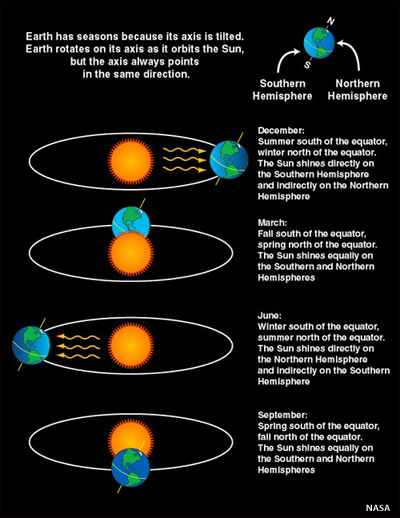
The diameter of the Sun is 864,000 miles, which is 109 times the size of the Earth. The diameter of the Earth at the equator is 7,926 miles.
Nuclear fusion
The Sun is a star that formed about 4.5 billion years ago. As a star, it has a finite life span. It is estimated the Sun is near middle age so no need to worry. The Sun has a few billion years of hydrogen left to fuse. By mass, the Sun is 70.6 percent hydrogen and 27.4 percent helium, according to NASA.
Nuclear fusion takes place at the Sun’s core where temperatures reach 27 million degrees Fahrenheit. At the surface, the Sun’s temperature is about 10,000 degrees Fahrenheit.
Parker Solar Probe
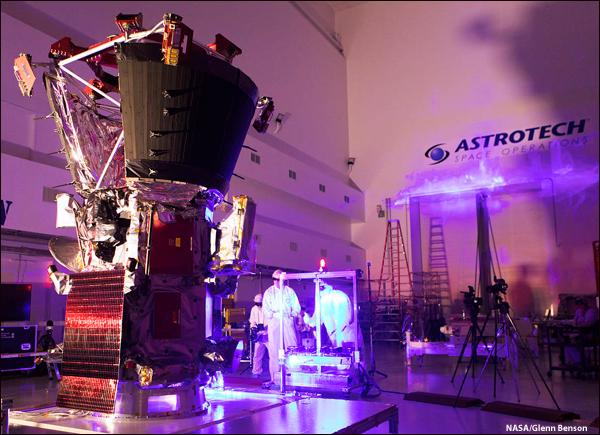
For the first time in history, an unmanned probe is studying the Sun’s atmosphere by flying into it. The probe is named after Dr. Eugene Parker, a physicist, who many years ago proposed theories based on complex mathematical calculations of how stars, including the Sun, give off energy. He proposed there was a cascade of energy called the solar wind coming from the Sun. Dr. Parker studied temperature differences on the Sun’s surface. Many of his theories have proven correct since he began his work in the mid 1950s.
The Parker Solar Probe launched from Cape Canaveral Air Force Station on Aug. 12, 2018.
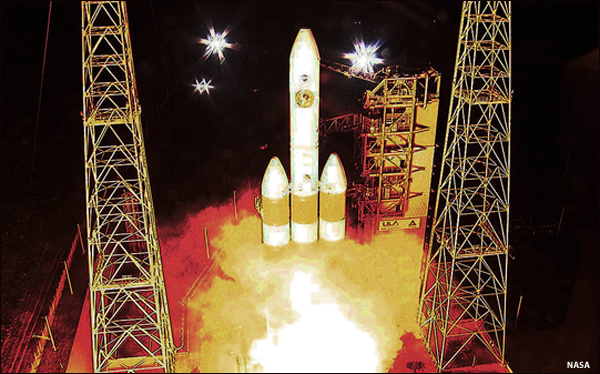
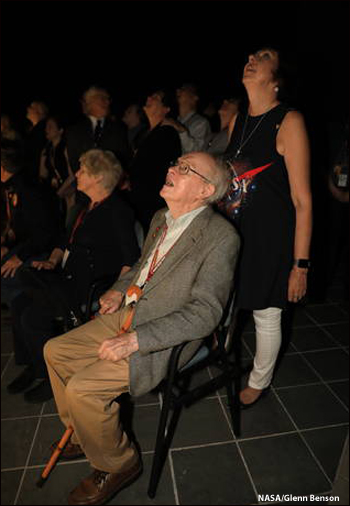
Dr. Parker was there to watch the launch. He passed away on March 15, 2022 at the age of 94.
“We were saddened to learn the news that one of the great scientific minds and leaders of our time has passed,” NASA Administrator Bill Nelson said after his death. “Dr. Eugene Parker’s contributions to science and to understanding how our universe works touches so much of what we do here at NASA. Dr. Parker’s legacy will live on through the many active and future NASA missions that build upon his work.”
Hydrogen and Helium Gas on Earth
Most hydrogen on Earth is present in the form of water, a molecule made of two hydrogen atoms and one oxygen atom (H2O).
Hydrogen gas by itself is explosive. Because the gas is lighter than air, hydrogen gas was used extensively in the early 1900s to power airships, also called dirigibles. The German Zeppelin class of airships transported passengers and cargo. On May 3, 1937, the Hindenburg, a German airship powered by hydrogen gas, left Frankfurt, Germany for a trip across the Atlantic Ocean and the United States. On May 6, 1937 as it was landing in New Jersey, it caught fire.

and then the ship burst into flames.(Courtesy: National Air and Space Museum)
Of the 97 people on board, 35 died in the fire. A reporter who watched in horror as the Hindenburg ignited and then burned in seconds famously commented, “Oh, the humanity.” The actual cause of the fire was never determined but there are a number of plausible theories. The era of airships to transport people and cargo ended.
Helium gas is not as flammable as hydrogen so helium is used in balloons to this day. In the United States, helium is extracted from wells in Texas, Oklahoma and Kansas.
REVIEW QUESTIONS
1. What is the distance between the Earth and the Sun?
2. What two elements make up the Sun’s mass?
3. How does the Sun produce energy – heat and light for the Earth?
4. How old is the Sun?
5. What is the most abundant element in the universe?
6. In what form is most of the hydrogen on Earth?
7. Write eight billion as a number. How many zeros does it have?
INQUIRY QUESTIONS
1. Why do helium balloons ascend if someone lets go of the string?
2. Why is helium used in balloons instead of hydrogen?
3. Why don’t we have to worry about the Sun running out of hydrogen?