

Nov. 1, 2020 – It’s a familiar smell that always prompts a rush to cover one’s nose to avoid smelling more of it. People describe the smell of hydrogen sulfide (H2S) gas as similar to the smell of rotten eggs. The smell can permeate the air when homes use well water containing sulfur to water lawns. And it can fill the air at remote spots with hot springs, such as national parks in the west that are volcanoes. Closer to home, a type of sulfur gas is produced when an onion is chopped and the gas is such an eye irritant causing tears to begin to flow as the eye defends itself.
Hydrothermal Features
Hot springs are one type of a “hydrothermal feature” (hydro = water and thermal = heat). Other hydrothermal features include geysers, mudpots and steam vents (fumaroles). Yellowstone National Park in Wyoming contains one-half of the world’s active geysers. There are more than 10,000 hydrothermal features in the park that encompasses 28,000 square miles. Yellowstone was the first national park. It was established in 1872 to preserve its unique geologic features and is still considered an active volcano.
To the southwest of Yellowstone in northern California is Lassen Volcanic National Park where all four types of volcanoes and many hydrothermal features are found.
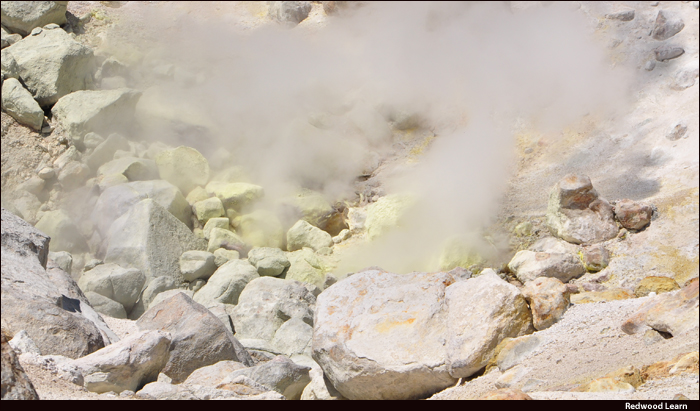
(Photo: Redwood Learn)
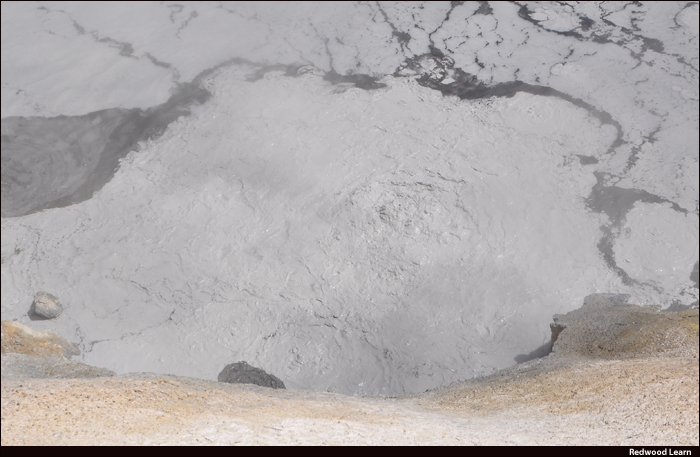
A mudpot is the middle phase between a fumarole and a boiling spring.
(Photo: Redwood Learn)
What causes hydrothermal features in these parks? The answer begins at Earth’s core some 4,000 miles below the surface.
Earth’s inner core is made of iron and nickel and is solid. Around the inner core is an outer core also made of iron and nickel but it is not solid. Abuot 1,400 miles thick, this outer core is hot and molten (liquid that flows). Above the outer core is the mantle. The mantle contains magma, which is semi-solid rock. Above the mantle is Earth’s crust from three to 48 miles thick where the continents and ocean floor formed.
In Yellowstone and Lassen, magma beneath the crust forms plumes in the mantle. These magma reservoirs transfer heat to the surface creating hot spots. Water boils at 212 degrees Fahrenheit. Geysers, mudpots and hot springs can have temperatures approaching or exceeding the boiling point of water. In addition, sulfur in magma forms sulfur compounds, such as hydrogen sulfide gas (H2S) and sulfuric acid (H2SO4). The smell of rotten eggs permeates the air at many hydrothermal sites.
2004 incident at Yellowstone National Park
In 2004, park rangers noticed five dead bison one morning and investigated. They found high concentrations of H2S gas at two locations. When H2S is present in air from one to 30 parts per million (ppm), the air smells like rotten eggs. Above 30 ppm and to 100 ppm, the odor is described as “sickingly sweet.” Above 100 ppm, an odor cannot be detected.
Rangers recorded measurements at two steam vents of more than 200 ppm of H2S and concluded the bison died of toxic sulfur gas. High levels of carbon dioxide (CO2) gas can also be produced in these steam vents and are toxic. The bison deaths could have been caused by high H2S and CO2 levels.
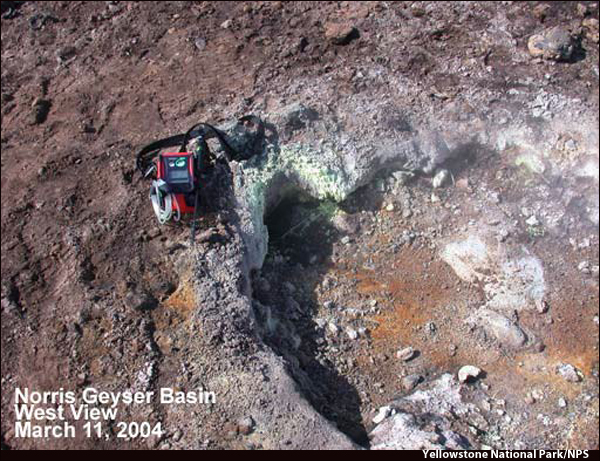
around the opening. (Photo: Yellowstone National Park/NPS)
Cutting Onions
Not toxic at all, cutting onions stimulates the production of a type of sulfur gas that irritates the eye. When the eye is irritated, its defense is to produce tears to wash out what is there. Onions only produce this gas when cut because of a sulfur compound from the soil in which the onion grew. White, yellow and red onions have higher amounts of this sulfiur compound than green onions (scallions) so that is why people do not tear as much when cutting scallions. Also, some people are not as sensitive to the gas and do not cry when cutting onions.
REVIEW QUESTIONS
1. What is the atomic number and symbol for sulfur, a chemical element?
2. What is the origin of its name?
3. What causes a person to form tears when cutting onoins?
INQUIRY QUESTIONS
1. At hydrothermal features common around volcanoes, what causes the “rotten egg” smell?
2. Why is sulfuric acid so caustic?
3. How did park rangers determine how the herd of bison died at Yelllowstone?