
Nov. 10, 2020 – Thousands of soldiers’ lives were saved in the days and weeks following the D-Day invasion on June 6, 1944. They were saved by a new antibiotic – penicillin. Dr. Alexander Fleming, a doctor at St. Mary’s Hospital in London, discovered penicillin in 1928 but could not extract enough of it in a stable form to work with it.
It’s not possible to verify the well known story that in 1928, Fleming accidentally discovered penicillin by leaving the lid off a petri dish when he went on vacation. The petri dish was growing Staph bacteria and was near an open window. Eric Lax, author of The Mold in Dr. Florey’s Coat, said in his book the story of how Fleming actually discovered penicillin has been lost to history. But Fleming did discover penicillin.
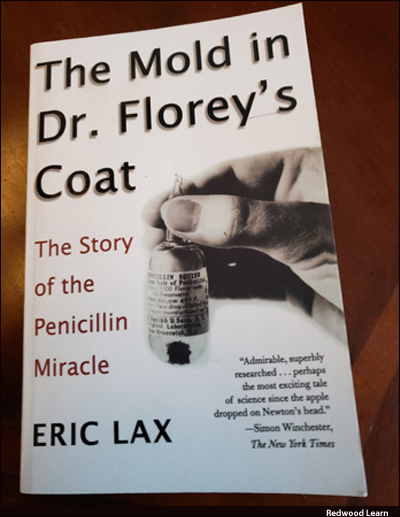
the discovery and mass production of penicillin during WWII.
(Photo of book: Redwood Learn)
In 1928, one of Fleming’s many petri dishes had been contaminated with a mold. Around the mold growth, Fleming noticed the area was clear. Staph bacteria were not growing there. He surmised (thought or deduced) that something from the mold killed the bacteria. He tried extracting the substance. He called it penicillin because the mold was from the genus, Pencillium. But the substance was unstable. He could not work with it. He wrote a paper about it in 1929. By 1932, his had stopped working with penicillin.
1939- 1940
In 1939, Dr. Howard Florey and scientists at the University of Oxford in England were curious about the substance Fleming discovered ten years earlier.
Scientists in the Dunn School of Pathology read Fleming’s 1929 paper. They were curious about penicillin. Dr. Howard Florey and Ernst Chain took up where Fleming left off. They began extracting penicillin from Penicillium mold.
By 1940, Europe was at war. England was defending itself against Nazi Germany’s quest to create a new world order with a reunited German Empire in control. Florey and Chain worried their lab would be bombed as Germany conducted a “Blitz” in fall 1940 by dropping bombs on London and other British cities for 57 consecutive nights. They decided to rub Penicillium mold on their lab coats in case everything was destroyed in their lab. Mold spores survive for a long time even on clothes.
England successfully defended itself. Germany never took control of England. But World War II continued.
1941
After isolating only small amounts of penicillin, Dr. Florey and another scientist came to the United States in summer 1941 seeking pharmaceutical companies that would agree to produce penicillin. They also sought help from the U.S. government to continue their research on how to produce large quantities of penicillin from the mold.
The U.S. Department of Agriculture (USDA) lab in Peoria, Illinois was the perfect place to continue their penicillin research. Six months later after Japan attacked the U.S. Navy in Pearl Harbor, Hawaii on Dec. 7, 1941, America was also at war. Large quantities of penicillin would be needed.
1943-1944
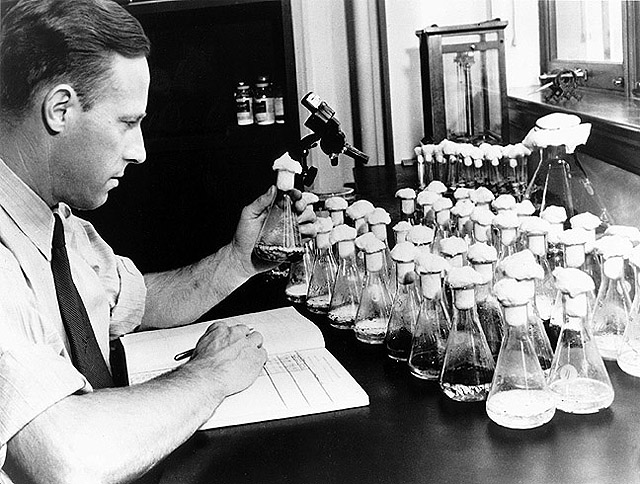
The Peoria lab searched around the world for Penicillium strains that would be super strains producing large amounts of penicillin. In summer 1943, they struck gold at home. A moldy cantaloupe from a Peoria market close to their lab had a strain of Penicillium (Penicillium chrysogenum) that produced 200 times the amount of previous strains. And then after applying ultraviolet (UV) light, the strain produced 1,000 times the amount of penicillin. This strain supplied most of the world’s supply of penicillin during World War II and in the years after the war.
In Brooklyn, New York, Pfizer, a pharmaceutical company, converted an old ice factory to a factory producing penicillin. They perfected deep tank fermentation. Other companies – Abbott Laboratories, Merck and Squibb – also produced penicillin. Eventually, more than 20 pharmaceutical companies were supplying the Allies with penicillin.

invasion on June 6, 1944. The women are packaging penicillin. The ad says limited amounts of penicillin are now available for civilians.
(Photo of page from magazine – Redwood Learn)
By D-Day on June 6, 1944, 100 billion units of penicillin were being produced in total each month. That amount was enough to treat 40,000 infections. It saved thousands of soldiers’ lives.
Soon it was available to the public. Mass production resulted in a price decrease from $200 to treat one case to $6. By the late 1940s, Pfizer was producing more than one-half of the world’s supply of penicillin.
Alexander Fleming, Howard Florey and ernst Chain jointly received the Nobel Prize in Physiology or Medicine in 1945, the year WWII ended.
REVIEW QUESTIONS
1. When and by whom was penicillin discovered?
2. Why did Fleming stop his penicillin research by 1932?
3. When did Dr. Howard Florey and Ernst Chain begin researching penicillin?
4. What challenge had to be overcome in order to produce large amounts of penicillin?
INQUIRY QUESTIONS
1. Why was penicillin production made a high priority in 1944?
2. What was the international collaboration that resulted in successful production of enough penicillin for soldiers on D-Day (June 6, 1944)?