

Dec. 1, 2020 – Sixty-five years ago today, Rosa Parks quietly sat in her assigned seat on Montgomery City Bus No. 2857 in Alabama to stand up for her civil rights and millions of other African Americans. She was not physically tired when the bus driver told her to give her seat to a white passenger. She refused. She was tired of inequality simply because of her skin color. Her peaceful action of intransigence was louder than 1,000 words. For her action, she was arrested, paid a fine and released.
Her action sparked the Montgomery Bus Boycott. It was successful.
For more than one year, African Americans in Montgomery did not ride city buses. The city lost significant revenue. And then the Supreme Court ruled it was unconstitutional to segregate people on city buses and at schools based on race. Cities had done this under Jim Crow laws.
The boycott and court rulings helped end racial injustices.
The modern Civil Rights Movement, led by Dr. Martin Luther King, Jr., an end to Jim Crow laws and passage of the Civil Rights Act of 1964 all followed from Rosa’s action.
Douglas Brinkley, author of Rosa Parks: A Life (2000), wrote Rosa’s definitive biography. The book is well researched. It’s a gift to history for present and future generations so readers can walk in Rosa’s steps as she tirelessly fought to end racial discrimination.
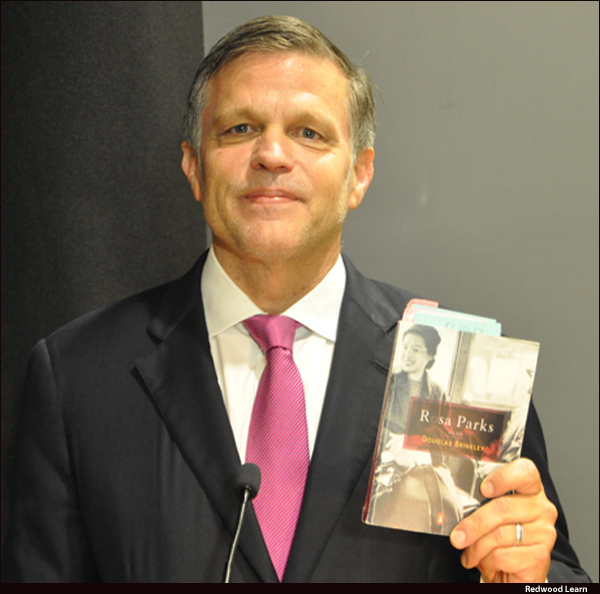
on Sept. 24, 2018 at a Symposium about her life. (Photo: Redwood Learn)
Rosa Parks and Raymond, her husband, moved to Detroit, Michigan in 1957 where she worked for many years in the Detroit office of U.S. Rep. John Conyers (D-Mich.) helping his constituents. She retired in 1988. Rosa died on Oct. 24, 2005. She was 92.
Rosa is known as the “Mother of the Civil Rights Movement.” Dr. King is known as the “Father of the Civil Rights Movement.”
In 2018, Redwood Learn hosted a Symposium, held at the University of Iowa in Iowa City, featuring Dr. Brinkley discussing Rosa Parks and his book. His 45-minute address can be seen below, divided into three parts.