

June 25, 2021 – On Sept. 17, 1787, the United States of America, just 11 years after declaring independence from England, adopted a new Constitution to govern the nascent, sovereign nation. It established three branches of government – executive, judicial, and legislative – and outlined how this new experiment in government by the people would work. The form of government is a “constitutional republic.”
In 1787, delegates from the 12 states spent many months writing the Constitution after determining the Articles of Confederation that were in effect since the Revolutionary War ended could not be revised. The Articles of Confederation simply did not reflect the scope of the new experiment in democracy the country had fought so valiantly to achieve. Many people thought the federal government needed to have more power.
On Sept. 17, 1787, delegates meeting in the Assembly Room at Independence Hall in Philadelphia voted to adopt the new Constitution. Three-fourths of the states then had to ratify it for it to take effect.
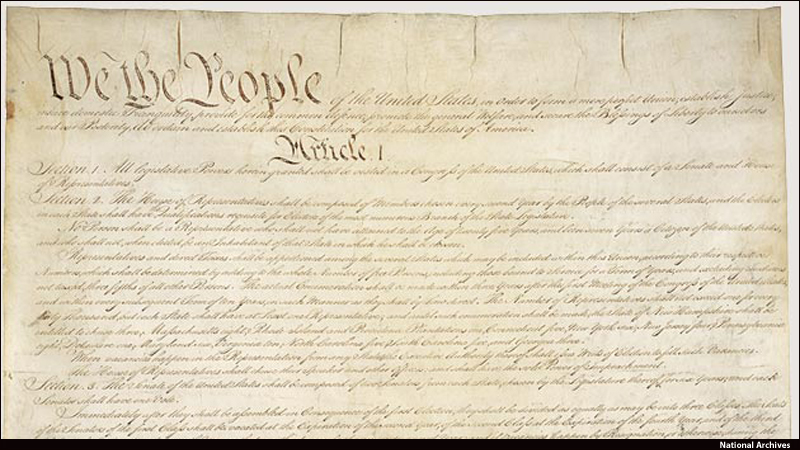
People today still admire the brilliance of the Founding Fathers. They designed the federal government with a system of checks and balances by setting up three co-equal branches of government – the executive branch (President and the administration), the legislative branch (U.S. Congress: senators and representatives) and the judicial branch (judges). Countries around the world have modeled their government in a similar way.
The following is a timeline highlighting key developments along the road to independence and the final ratification of the US Constitution.
Timeline
1768: British “redcoats” occupied Boston.
1773: Boston Tea Party — Colonists took bold action to let the British know many American colonists did not want to pay taxes without a voice (representation). They dumped an entire shipment of tea (about 45 tons) into Boston Harbor.The tea had arrived in Boston on ships from the British East India Company.
1775: April 19 — The first shots were fired in the American Revolution at Lexington and Concord, Massachusetts.Paul Revere took his famous midnight ride to warn John Hancock and Samuel Adams that the British were coming to arrest them and to disarm the colonies.
1775: June 17 — The Battle of Bunker Hill took place in Boston. It was the first battle where British soldiers and American colonists engaged in direct battle.
1776: July 4 — The American rebels, called Patriots, issued the Declaration of Independence after approving the document in Philadelphia at a Continental Congress of delegates.
1776: Dec. 26 — George Washington led the Continental Army to victory in the Battle of Trenton after crossing the Delaware River from Pennsylvania to New Jersey on Christmas night.
1781: With help from France, the American colonists defeated the British at the Battle of Yorktown, a decisive victory.
1782: Peace negotiations began in Paris.
1783: Sept. 3 — The Treaty of Paris was signed to officially end the Revolutionary War. England agreed that the United States of America was a sovereign country.
1787: In the four years since the Treaty of Paris ended the Revolutionary War, many people argued for a stronger federal government. In May, 55 men from 12 states gathered in Philadelphia to chart a new path for the federal government.
1787: Sept. 17 — Thirty-nine delegates to the Constitutional Convention signed the Constitution. Three-fourths of the states had to ratify the Constitution in order for it to take effect. Delaware was the first state to ratify it.
1788: June 21 — New Hampshire became the ninth state to ratify the Constitution fulfilling the three-fourths requirement. The Constitution took effect. All agreed that the government would begin operating on March 4, 1789. George Washington was unanimously elected the nation’s first president.
1789: April 30 — Due to a delay because of weather and travel, George Washington was inaugurated at Federal Hall in New York City. Subsequent inaugurations were held on March 4 as designated in the Constitution.
1791: The first ten amendments to the US Constitution, known as the Bill of Rights, were ratified. The Bill of Rights stated the rights American citizens had.
Modern Day
The Declaration of Independence, the Constitution and the Bill of Rights comprise the Charters of Freedom. To study these founding documents, visit the National Archives.
On Constitution Day (September 17), read the document and the amendments. It’s still in the news and being debated 233 years after it was adopted and then ratified. Some people today believe in a strict interpretation of the Constitution. Others believe in interpreting the document relevant to the times. Have a thoughtful and civil debate after reading and studying the Constitution.