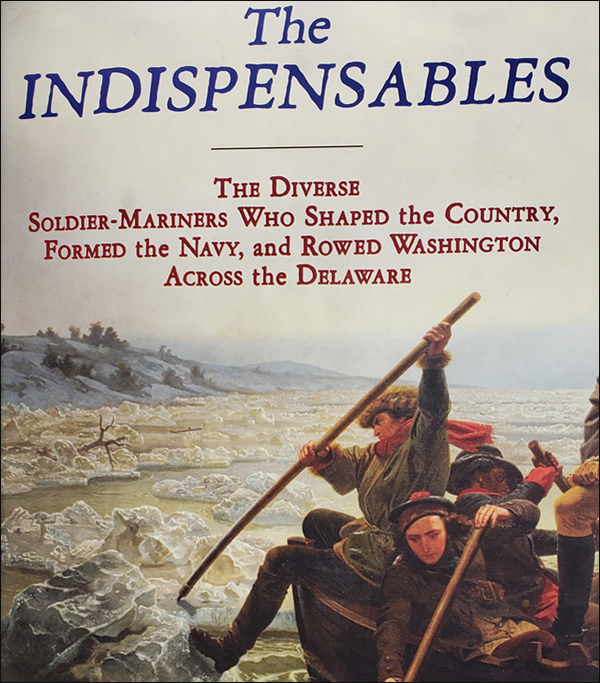
Featured image above: Cover of The Indispensables: The Diverse Soldier-Mariners Who Shaped the Country, Formed the Navy, and Rowed Washington Across the Delaware, a book by Patrick O’Donnell that was released in 2021.

Editor’s note: This article was originally published in 2023. It has been updated and edited. 

Jan. 18, 2026 – February is a month of bitterly cold temperatures in northern states and cold temperatures in many southern states with an occasional temperature at or just below freezing. To warm the heart, Valentine’s Day falls in the middle. One week later, it’s a federal holiday – Presidents’ Day (officially George Washington’s Birthday), always on the third Monday in February.

Presidents’ Day honors President Abraham Lincoln and President George Washington because both men were born in February. George Washington was born on Feb. 22, 1732 in Virginia. He was the nation’s first president. Abraham Lincoln was born on Feb. 12, 1809 in Kentucky. He was the nation’s sixteenth president.

This article’s focus is on George Washington and a book written by Patrick O’Donnell. He uncovered details that few people know about Gen. George Washington crossing the Delaware River on Christmas Day in 1776. The book is: The Indispensables: The Diverse Soldier-Mariners Who Shaped the Country, Formed the Navy, and Rowed Washington Across the Delaware.

George Washington (1732-1799)
Hundreds, if not thousands, of books have been written about George Washington, the Commander of the Continental Army, an Army of colonial militias that, against all odds, defeated the British to gain independence for the United States of America. The odds against Washington and the rebel patriots were astronomical. England had the most powerful navy in the world in 1776 and well trained infantry troops.

Under British rule, the colonists did not have their own military, just local militias to oversee local matters. But as colonists grew angry with the imposition of taxes on them through votes in the British Parliament in England, they began organizing militias to challenge British rule.

On Dec. 16, 1773, three years before Washington crossed the Delaware River, a group of colonists protested British taxes by dumping a load of tea, being imported to America, into Boston Harbor.

A replica of an 18th century ship that visitors can tour is docked in Boston Harbor where the Boston Tea Party took place in 1773. (Photo: RET)

George Washington believed in colonists’ right to govern themselves. He became convinced that the only course of action was to break away from England and form a sovereign nation – the United States of America. With his experience as an officer in the French and Indian War (1754-1763) and his leadership skills, he was the perfect choice to become the Commander of the Continental Army.

The American Revolution began on April 19, 1775 with the “shots heard around the world” at Lexington and Concord, Massachusetts when colonists and British troops engaged in the first battle of the war.

On July 4, 1776 in Philadelphia, the colonists formally declared their independence from England when representatives meeting at the Continental Congress at Independence Hall voted to adopt the Declaration of Independence.

A pivotal moment in the fight for liberty came on Dec. 25, 1776 when Gen. Washington devised a brilliant plan to surprise the British (really Hessian soldiers from Germany helping England) at Trenton, New Jersey. Washington surprised them by crossing the Delaware River at night in a snowstorm. While a couple of his units were not able to cross, Washington was guided by a diverse group of soldiers who were mariners, people who worked on the seas and were experts at navigating the often treacherous waters. This group of men made the crossing successful and ultimately, victory possible. The unit was comprised of African Americans, Native Americans, Hispanics and Caucasians.

It’s a story that was lost to history until Patrick O’Donnell released his book in 2021 about the amazing historical event based on his extensive research. What a terrific way to honor Presidents’ Day by reading the book and then telling others about it.