Editor’s Note: In 2014, I began attending Rosie Rallies in Michigan where I met a number of women who went to work in factories during World War II – original Rosies. Their stories were riveting! As I read more about these amazing women, I learned that 60 percent of Rosies were age 35 and older. The article below summarizes stats about the Rosies. The story was first published in 2021. It has been updated and edited. And check out the related posts, with video, of my 2017 interview with Mae Krier, and Phyllis Gould, both original Rosies.

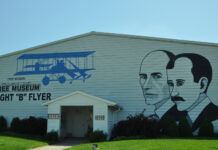
Jan. 26, 2026 – In March 1941 when 25 women completed training at a Vultee airplane factory, their first day of work was scheduled for April 1. A group of women would join men on a factory assembly line for the first time. But factory managers thought people would think it was an April Fools Day joke seeing women working in a factory so their first day of work was moved up to March 31, 1941.

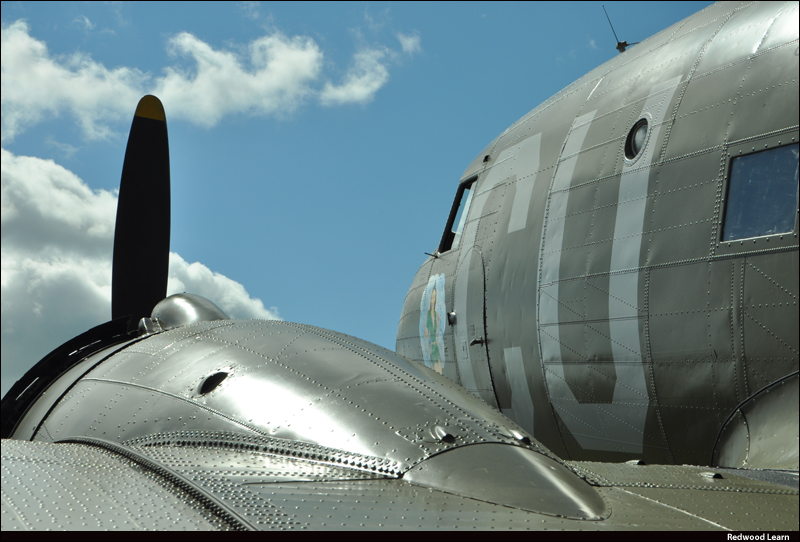
This WWII C-47 has 500,000 rivets. Women had to learn all of the different sizes of rivets and then worked with another person, a bucker, to place each rivet on the plane. On May 16, 2019, this C-47 prepares for its journey across the Atlantic Ocean for the 75th anniversary of D-Day. (Photo: RET)

Fast forward 85 years and women are still riveting, welding and performing many highly skilled factory jobs. Known collectively as Rosie the Riveter, women who went to work in factories in the 1940s paved the way for future generations of women. But women first went to work because of the potential to earn a high wage and to serve their country’s war effort. They did not go to work to make a point about women being able to do a man’s job. That aspect came later as women proved they were capable workers and wanted to remain working at factories.

The iconic image of Rosie the Riveter was first published in 1942 in a company newsletter at Westinghouse during World War II to motivate their female workers.

Poster: “We Can Do It!” or Rosie, the Riveter. (The National Museum of American History/Smithsonian Institution)

And the name “Rosie the Riveter” was first used in 1941 as the name of a song released by The Four Vagabonds. Rosie as it is known today did not become popular until the 1980s when the Westinghouse poster was found and used to promote the role of women entering the workforce during World War II. Today the image is known worldwide and included on many products.

An original copy of the “Rosie the Riveter” sheet music for the song, released in 1941, by The Four Vagabonds. (Photo: RET)

Early 1940s – Rosie Goes to Work

In the early 1940s, factory managers resisted hiring women because they felt women would not be able to perform as well as men. Instead, when their male workers were drafted into the military, beginning in September 1940, and then during World War II from 1941 to 1945, factory managers asked draft boards for waivers to allow their male workers to remain at the factory.

Eventually, the demand for men in the military was so high that draft boards denied the vast majority of waiver requests. They told managers to hire women to fill the void left by their workers going off to war. Reluctantly, factories began hiring, training and employing women. Women quickly proved themselves. And in some jobs, such as electrical assembly and riveting, women excelled because of their small hands and ability to fit into small spaces inside airplane wings. In addition, women demonstrated a deep commitment to their jobs as they learned how important their job was to win the war so their brothers, husbands and sons could come home.

A “Rosie” works on the Vengeance bomber at the Vultee plant in 1943 in Nashville, Tennessee. (Photo: Library of Congress)

By the Numbers

By the end of 1942, the total workforce was 59.6 million people. That number was an increase of 3.9 million people from 1941. And of that total of 59.6 million people in the workforce in 1942, 15.5 million were women. That number is 1.7 million more women in the workforce in 1942 than in 1941.

From December 1941 to December 1942, the number of women employed in defense industries increased from 4.8 million to 11.3 million. By the end of 1942, 29 percent of people employed in defense industries for the war effort were women, an increase from 13.4 percent at the end of 1941. These intrepid women blazed a trail in the 1940s and for generations to come. By the end of 1944, about 37 percent of all workers in defense industries were women.

Depending on the industry, the percent of women varied from about 22 percent in the iron and steel industries to about 70 percent at the Kaiser shipyards in Richmond, California where more than 700 Liberty Ships were built from 1942 to 1945.

At the shipyards, Rosie the Riveter had a sister – Rosie the Welder. It’s fascinating to study the ages of women (about six million) who went to work in factories. The following stats from the book, Rosie the Riveter: Women Working on the Home Front in World War II by Penny Colman (pp.106 to 107) tell the story of the Rosies working in factories:

Ages 35 and older: 60 percent

Ages 20-24 years: 22 percent

Ages 14-19 years: 17.2 percent (Note: Child labor laws were suspended during World War II)

Ages 25-34 years: one-half of one percent (0.5 percent)

Congressional Gold Medal

The Congressional Gold Medal Act of 2019 recognizes the six million women who went to work in factories making materials for the war effort. Sponsored by Sen. Robert Casey (D-PA) in U.S. Senate and Rep. Jackie Speier (D-CA) in the U.S. House of Representatives, the law authorized the U.S. Mint to create a Congressional Gold Medal to represent all of the Rosies. With Rosies in the Oval office, President Obama signed it into law on Dec. 3, 2020.

The Rosie the Riveter Congressional Gold Medal (U.S. Mint)