

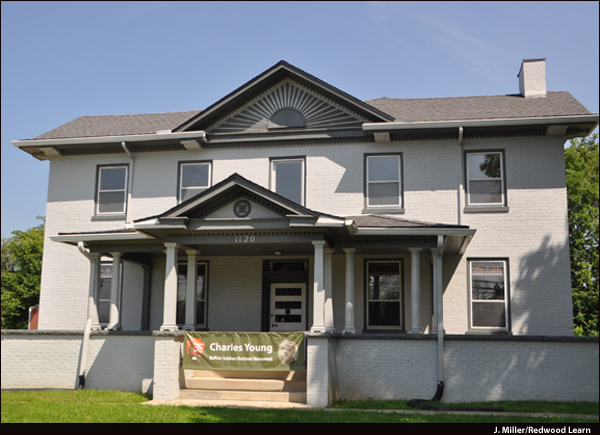
March 6, 2021 – Walking up the steps to the front porch of the Charles Young home and since 2013, the Charles Young Buffalo Soldiers National Monument in Wilberforce, Ohio, one can vividly imagine conversations that took place there at the dawn of the 20th century. Orville and Wilbur Wright might be there along with Paul Dunbar, their friend who was an internationally known African American poet. And then one can see Charles Young and W.E.B Du Bois sitting on the porch discussing their work at Wilberforce College.
Charles Young (1864-1922)
Charles Young (1864-1922) was an African American youth from the Midwest. President Lincoln’s 1863 Emancipation Proclamation freed his family from the bonds of slavery. Yet Charles still had to confront the raw realities of racism throughout his life. But he persevered to become Colonel Charles Young, the highest ranking African American soldier from 1894 until his death in 1922
He was the third African American to graduate from West Point. He graduated in 1889. It would be another 47 years before another African American graduated from the military academy. In 1936, Benjamin O. Davis, Jr. became the fourth African American West Point graduate. He would go on to lead the Tuskegee Airmen during World War II.
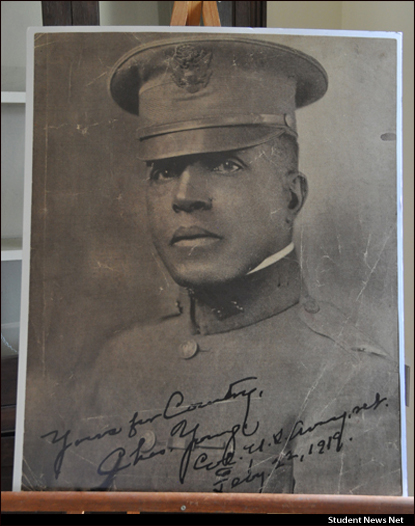
graduated in 1889 and remained in the U.S. Army for his career.
(Photo: Redwood Learn)
Young and his family bring to life the Emancipation Proclamation issued by President Abraham Lincoln in 1863. Charles was born in 1864, one year after slaves in “rebellious” states were freed. President Lincoln’s proclamation enabled Charles’ father to join the U.S. Army during the Civil War and for the Young family to live a life of freedom.
After the war, the Young family moved to Ripley, Ohio, an abolitionist center, where Charles attended and excelled at an integrated school.
West Point graduate
After his West Point graduation in 1889, Charles was commissioned a Second Lieutenant. He then embarked on a military career that had him stationed at home and abroad.
Native Americans coined the Buffalo Soldiers name for Black Army soldiers serving in the west on the frontier. There are a couple of different theories about why they were given this name. One theory is that Native Americans thought Black soldiers’ hair resembled buffalo hair. The name was a sign of respect as Native Americans revered the buffalo for its strength and speed. Young and his Ninth Cavalry, stationed in the West, liked the name.
Wilberforce College near Dayton, Ohio
Young traveled the world during his career as an Army officer. In 1894, he was assigned to Wilberforce College, the first private, historically Black college in the United States, located near Dayton, Ohio. Young’s task was to set up a new department of military science. Charles and the Wright Brothers crossed paths during this time. And Paul Dunbar, an African American poet and friend of the Wright Brothers, also became friends with Charles Young. All four men are honored at national park sites in Dayton and Wilberforce. Finally, while at Wilberfoce, Young met W.E.B. Du Bois, the first Black doctoral graduate from Harvard College. Du Bois was on the Wilberforce faculty from 1894-1896. Young and Du Bois became friends. The college exists today as Wilberforce University.
Charles was especially adept at drawing maps. That skill served him well in 1903 when he was appointed superintendent of Sequoia National Park in California. He was the first African American to lead a national park.
Young and his Ninth Cavalry were tasked with completing roads in the park that had been left unfinished by the previous superintendent. In his time there, he and his soldiers accomplished many goals for the park. In 1903, the National Park Service had not yet been set up as the agency to oversee all national parks. The U.S. Army managed the park.
As Young and his soldiers were in California clearing paths and paving roads, Orville and Wilbur Wright were in the final phases of building their airplane. On Dec. 17, 1903, they successfully flew their plane in North Carolina along the shores of the Atlantic Ocean.
Throughout his life, Charles faced discrimination and ridicule simply because of the color of his skin. He persevered through it all and stands today as a remarkable role model for all young people. He said the most important thing to have in life is confidence. Col. Young died in 1922.
320th Barrage Battalion – World War II
No doubt Col. Charles Young’s legacy was known to the Army’s 320th Barrage Balloon Battalion during World War II. It was the only all African American battalion to land on Normandy beaches on D-Day (June 6, 1944). About one million African Americans, mostly men, served in the military during World War II. About 16 million members of the Armed Forces (mostly men) served in the military during the war.
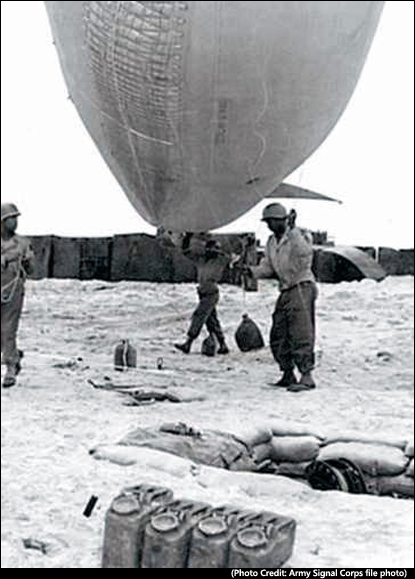
After World War II, the military became integrated in 1948 when on July 26, President Harry S. Truman issued Executive Order 9981. All barriers to service were removed for both men and women.
Charles Young paved the way for millions of African American youth and today remains a role model for all youth.
To learn more about Charles Young, read Black Officer in a Buffalo Soldier Regiment: the Military Career of Charles Young by Brian G. Shellum.
REVIEW QUESTIONS
1. During what significant event in American history was Charles Young born?
2. How did President Lincoln’s Emancipation Proclamation help the Young family?
3. When did Charles Young graduate from West Point?
4. Where is Wilberforce College?
5. What was Young’s job at Wilberforce?
6. What was Young’s job at Sequoia National Park?
INQUIRY QUESTIONS
1. During his time at Wilberforce, what remarkable friendships did Young form? What lessons can be learned from those friendships that are still relevant today?
2. Charles Young said confidence was very important in life. How do you think confidence helped him succeed during his Army career?
3. What role do you think Young’s excellent map skills had during his career?
4. Charles Young and friends:
One can only guess at the impact of the friendships Charles Young had with such important figures in American history as Orville and Wilbur Wright, Paul Dunbar and W.E.B. Du Bois. The following is a list of dates marking the birth and death of his friends.
Orville Wright (1871-1948)
Wilbur Wright (1867-1912)
Paul Dunbar (1872-1906)
W.E.B. Du Bois (1868-1963)
Of his friends, W.E.B. Du Bois would be the only one to live to see the U.S. Army integrated. Discuss how W.E.B. Du Bois must have been thinking of his friend Charles Young in 1948 when President Truman ordered all branches of the military integrated.