

Aug. 31, 2020 – On Aug. 10, 2020, a derecho (deh-REY- cho) blew through the Midwest. A derecho is a weather event that has hurricane-force winds. The August derecho caused widespread damage to crops growing in the “I” states (Iowa, Illinois and Indiana). Farmers are trying to salvage their crops. But millions of acres of corn in Iowa are too flat to harvest, according to Mark Licht, an agronomist with Iowa State University.
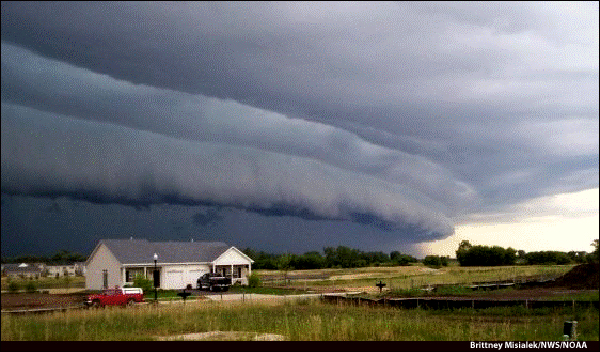
(Courtesy of Brittney Misialek)
The U.S. Department of Agriculture (USDA) posted a brief yet very informative audio interview with Mark on Aug. 28, 2020. There are not many options to harvest corn that was flattened in the derecho, Mark said.
What is the extent of the damage?
In their Aug. 14, 2020 update on the derecho damage in Iowa, the USDA Risk Management Agency (RMA) estimated 57 counties with a total of 14 million acres of insured crops were in the path of the derecho. A derecho is a straight line wind event associated with showers and/or thunderstorms.
Of the 57 counties, 36 counties suffered the most damage. From satellite imagery and reports from the ground, 3.57 million acres of corn and 2.5 million acres of soybeans were severely damaged. Losses will be in the billions of dollars because there was also extensive damage to grain bins, silos, barns and homes.
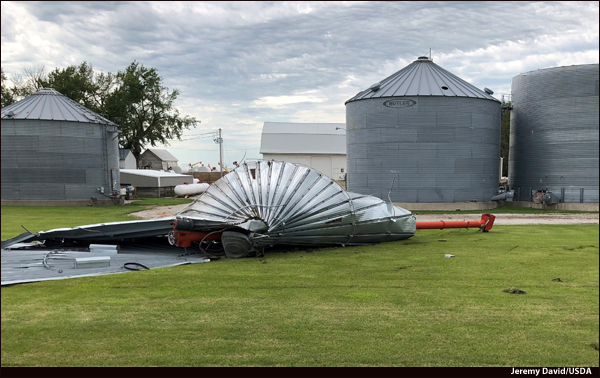
Mark explained that for corn to be harvested, it has to be from 12 to 18 inches off the ground. Corn damaged from the derecho is less than 12 inches off the ground. There are not many uses for downed corn, he added.
On Aug. 18, 2020, the USDA posted an audio interview (“Deciphering the Derecho”) with Brad Rippey, USDA meteorologist. It was fascinating and again, brief yet very informative.
Brad described a derecho as “one of the last great mysteries in weather forecasting.” Seemingly out of nowhere, straight-line, hurricane-force winds develop. Brad explained that the Aug. 10 derecho began in eastern Nebraska and then blew through the “I” states with official winds of 60 to almost 100 miles per hour (mph) recorded at airports. Unofficial wind speeds were reported at greater than 100 mph in certain rural areas.
Once formed, a derecho takes on a life of its own and a routine storm rapidly turns into a monster, Brad said. Meteorologists are studying these tragic weather events to be able to better forecast them in the future, he added. Derechos have been recognized for many years.
The National Weather Service (NWS) explains that the name was given to the weather event (phenomenon) by Dr. Gustavius Hinrichs, a physics professor at the University of Iowa in the early 1900s. The word derecho is Spanish for “right,” “direct” or “straight ahead.”
It’s a very difficult time for farmers impacted by the derecho, especially when they were already dealing with the COVID-19 pandemic.
Quote from Mike Naig, Iowa Secretary of Agriculture
“I’ve been touring some of the hardest-hit parts of the state this week to speak with farmers and agribusinesses that were impacted by the derecho,” Mike Naig, Iowa Secretary of Agriculture, said in an Aug. 14 press release. “These farmers put significant resources into this crop and were planning for strong yields. Now their crops have been damaged – some destroyed – and the state has lost tens of millions of bushels of grain storage just a few weeks before harvest begins. This is a devastating blow to the agricultural community that is still recovering from the pandemic.”
REVIEW QUESTIONS
1. What is a derecho?
2. What states were impacted by the Aug. 10, 2020 derecho?
3. What state is the top corn producing state in the United States?
4. What is an “agribusiness?”
INQUIRY QUESTIONS
1. What will likely happen to corn prices because of the derecho?
2. What government agencies help farmers after disasters such as the derecho?
3. In what ways do farmers rely on these government agencies?