

Nov. 19, 2020 – Artifacts provide a window into history. Things from the past can point the way to the future. Artifacts are often old and worn out but kept that way to tell a story. When the Henry Ford Museum of American Innovation acquired the Rosa Parks bus in 2001, they decided to restore it to its original appearance. They wanted visitors to be able to actually sit where Rosa Parks sat on Dec. 1, 1955.
With so many artifacts on display at museums, the story of how an iconic artifact is acquired is usually known to just a few curators and historians. The stories are likely to be riveting tales of research, forensics, and sometimes a little serendipity. That was the case for the story of how the Henry Ford purchased the Rosa Parks bus.
Interview with Christian Overland, former chief historian at the Henry Ford
The Rosa Parks bus is the most significant artifact of the civil rights movement, Christian Overland, formerly the chief historian at the Henry Ford in Dearborn, Michigan, said in January 2018 as he stood beside Montgomery, Alabama city bus #2857, the Rosa Parks bus.
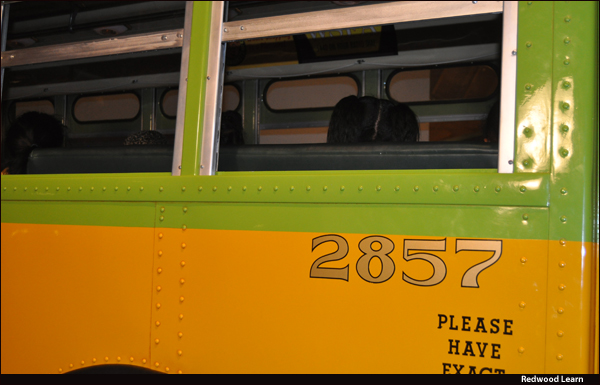
the Henry Ford Museum of American Innovation and restored. (Photo: Redwood Learn)
In 2000, the museum heard the bus was up for sale. But first, they had to have proof (provenance) that it really was THE bus Rosa Parks was riding that day. Christian explained the bus had been purchased by a private owner years before and used as a storage shed on a farm. All of the seats had been pulled out. And with years outside in all types of weather, the bus was rusted and run down.
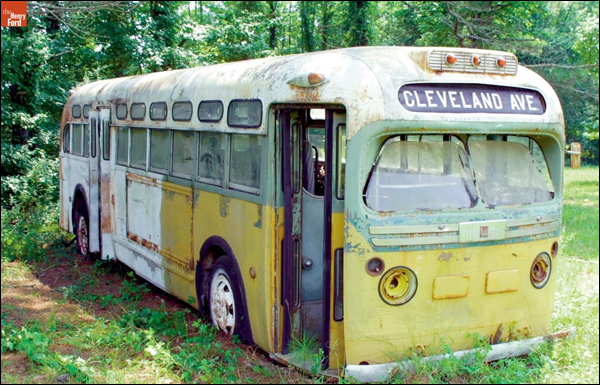
acquired it in 2001. (Photo: the Henry Ford)
The family of the owner who purchased the bus advertised it on eBay as the Rosa Parks bus. There were no bids. Christian said those were the early days of eBay when most items being sold were very small and trivial.
After failing to sell on eBay, the owners decided to put it up for auction. By now, forensic scientists and historians from the Henry Ford were sure it was the Rosa Parks bus. They found a scrapbook of newspaper articles from the Montgomery bus boycott in 1955-1956. The bus number in the articles matched the bus number on the bus being sold – #2857.
Did other museums realize what was up for auction? Time would tell. On the day of the auction, many museums bid on the bus. Word had spread that THE Rosa Parks bus was for sale.
The Henry Ford prevailed and purchased the bus for $427,000.
It was moved to Dearborn. Museum officials debated whether to restore it or leave it as is. They decided it needed to be restored so visitors could learn by doing, an important mission of the Henry Ford that includes Greenfield Village, a village where visitors can walk into Thomas Edison’s lab, Orville and Wilbur Wright’s home, and many other historical buildings. Visitors can even drive a Model T Ford.
With Liberty and Justice for All – the Henry Ford
Today the Rosa Parks bus anchors the exhibit – With Liberty and Justice for All. Along with the bus, three other important artifacts are on display. Those are: 1) an original copy of the Declaration of Independence, 2) George Washington’s camping cot, and 3) the chair in which President Lincoln was sitting when he was assassinated at Ford’s Theatre on April 14, 1865.
Going inside the Rosa Parks bus
Visitors to the Henry Ford can board the bus and sit in a seat. A piece of paper in one of the windows marks the seat where Rosa Parks sat on Dec. 1, 1955. On that fateful day, she had finally had enough and demanded her civil rights be honored. By sitting peacefully, she stood up for millions of African Americans and the rights promised to them in the Declaration of Independence that “all men are created equal.”
She was arrested and paid a fine.
Her community rallied around her. They began a bus boycott. Black citizens found other ways to get to work. Revenue dropped for the city. The boycott lasted for more than one year. Along with legal decisions saying the city could not discrimate against Black Amercians on public transportation, the boycott achieved its goal. City buses no longer had separate sections based on race.
In 1964, the Civil Rights Act was passed by Congress and signed by President Lyndon Johnson. In 1965, the Voting Rights Act was passed and signed into law.
In addition to the Henry Ford, many national park sites are devoted to telling the history of the Civil Rights Movement. (see links to the right)
REVIEW QUESTIONS
1. What peaceful action did Rosa Parks take on Dec. 1, 1955 that sparked the modern Civil Rights Movement?
2. What laws in the 1950s allowed for discrimination against Black Americans?
3. Why did the Henry Ford Museum of American Innovation want to purchase Montgomery City Bus #2857?
4. Once the museum purchased the bus, what did they do with it?
INQUIRY QUESTIONS
1. Why is the bus now considered the most iconic artifact of the Civil Rights Movement?
2. What is the legacy of Rosa Parks?
3. What lessons from Rosa Parks are still relevant today?