

Feb. 2, 2023 – As the nation honors Black History Month, take time to study the life of Dr. Martin Luther King, Jr., the ‘Father of the Civil Rights Movement.’ Along with Rosa Parks, the ‘Mother of the Civil Rights Movement,’ these two courageous Americans changed the course of history. Their lives are as relevant today as they were in the middle of the 20th century. Many people still quote from Dr. King’s 1963 ‘I Have a Dream’ speech in which he called for his children to be judged not by the color of their skin but by the content of their character.
2019 Redwood Learn article on Dr. King
Jan. 15, 2019 – On this day 90 years ago, Martin Luther King, Jr. was born in Atlanta, Georgia. His birthday is now celebrated as a federal holiday – MLK Day. It’s celebrated on the third Monday in January. As the “Father of the Civil Rights Movement,” Dr. King fought peacefully and valiantly his entire life for the promises made in America’s Declaration of Independence that all men are created equal.
Rosa Parks
On Dec. 1, 1955, Rosa Parks refused to give her seat on Montgomery City Bus No. 2857 to a white passenger after being instructed to do so by the bus driver. When she refused, she was arrested. Dr. King came to Montgomery following her arrest and release.

sat in a field. It was used as a storage shed. The Henry Ford restored the bus in 2001. It is
now the centerpiece of their “Liberty and Justice for All” exhibit. (Photo: The Henry Ford)
Rosa first met Dr. King on Aug. 14, 1954 at a NAACP meeting at the Metropolitan United Methodist Church in Montgomery, Alabama. Dr. King came to speak about the Brown vs. Board of Education Supreme Court decision that was issued on May 17, 1954.
Quotes from Rosa Parks: A Life by Douglas Brinkley (2000)
On page 100 of his book, Dr. Brinkley writes:
“On that day [Aug. 14, 1954], Rosa Parks had her first encounter with Dr. Martin Luther King, Jr. whose name would someday be one of the few from the civil rights movement more famous than her own. Thus, their first meeting, which has been left out of most biographies of King, is worthy of note. That evening, only thirty people showed up for King’s NAACP address on the Brown decision – most of them women. Sitting up front were Rosa Parks and Johnnie Mae Carr, along with branch president Robert L. Matthews. Midway through King’s speech, a mesmerized Carr elbowed her friend in the ribs and whispered: ‘He’s something else.’ Parks responded, ‘He sure is!’ According to Carr, their “jaws dropped” at King’s mastery of his subject and at the cadences of his soaring deep voice. ‘I was very impressed by his eloquence,’ Parks remembered.”
After Rosa’s arrest on Dec. 1, 1955 and her release, local African American leaders met and decided to start a peaceful bus boycott to support Parks’ action. The group recruited Dr. King to help. On Dec. 5, 1955, Dr. King addressed thousands of people at the Holt Street Baptist Church to encourage everyone to participate in the bus boycott.
On pp. 138-139, Brinkley describes Dr. King’s address that evening. He writes:
“When the time came, rousing words flowed out of his trumpetlike baritone seemingly without effort. Much of his impromptu oration, delivered without notes or text, focused on lauding Rosa Parks for her impeccable character and the extraordinary bravery of her David-like defiance of the Goliath known as Jim Crow. ‘Since it had to happen,’ King said of her arrest, ‘I’m happy it happened to a person like Rosa Parks, for nobody can doubt the height of her character, nobody can doubt the depth of her Christian commitment.’ King went on: ‘But there comes a time that people get tired. We are here this evening to say to those who have mistreated us for so long that we are tired – tired of being segregated and humiliated; tired of being kicked about by the brutal feet of oppression.’ To Patk’s embarrassment, every praise King heaped on her prompted jubilant applause. ‘We have no alternative but to protest,’ he continued, thrusting his hands forward for emphasis. ‘For many years we have shown amazing patience. We have sometimes given our white brothers the feeling that we liked the way we were being treated. But we come here tonight to be saved from the patience that makes us patient with anything less than freedom and justice.’ King electrified the audience.”
Rosa Parks and Dr. Martin Luther King, Jr.
The Montgomery Bus Boycott lasted until Dec. 20, 1956, more than one year after Rosa’s action. The world came to know Rosa Parks and Dr. Martin Luther King, Jr. as peaceful civil rights activists.
Eventually, the Supreme Court (Browder v. Gayle) ruled it was unconstitutional to segregate people on public transportation – and in schools – based on race. Rosa and Dr. King continued the long struggle for equality. Rosa and her husband, Raymond, moved to Detroit because of threats against their lives. Rosa worked for more than 25 years for U.S. Rep. John Conyers and continued her civil rights work helping his constituents. She died in 2005.
On Aug. 28, 1963, Dr. King once again mesmerized a large crowd when he delivered his famous ‘I Have A Dream’ speech at the Lincoln Memorial during the 1963 March on Washington for Jobs and Freedom. He said he was there to turn in a promissory note made in the Declaration of Independence. That note said all men are created equal.
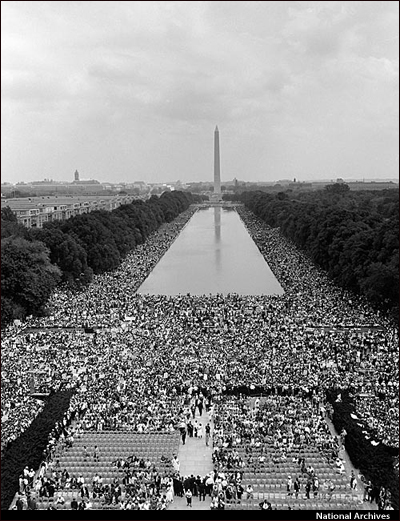
Washington for Jobs and Freedom. (Photo: National Archives)
After President John. F. Kennedy (JFK) was assassinated on Nov. 22, 1963, Dr. King worked with Congress and President Lyndon Johnson on new civil rights legislation (laws). The 1964 Civil Rights Act was signed into law. In 1965, Congress passed and President Johnson signed the Voting Rights Act.
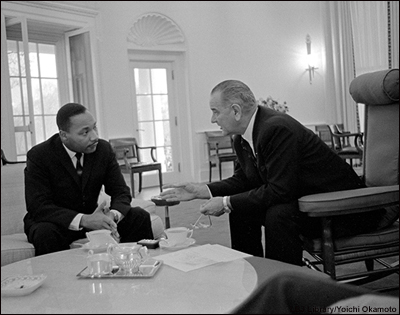
on Dec. 3, 1963. (Photo: LBJ Library/Yoichi Okamoto)
On April 4, 1968, Dr. King was assassinated in Memphis, Tennessee where he was supporting sanitation workers who were striking for better working conditions.
In 2011, the MLK Memorial opened on the National Mall in the nation’s capital. It’s steps away from the Lincoln Memorial.
REVIEW QUESTIONS
1. When did Rosa Parks and Dr. King first meet?
2. How did Dr. King help Rosa after her arrest on Dec. 1, 1955 for not giving her bus seat to a white passenger?
3. What was the Montgomery Bus Boycott?
INQUIRY QUESTIONS
1. What effect do you think the long Montgomery Bus Boycott had on the city of Montgomery?
2. Why are Dr. King and Rosa Parks known as the Father and Mother of the Civil Rights Movement respectively?
3. Read Dr. King’s famous “I Have a Dream” speech through the related link. What type of speech was it? What was its purpose? Did it achieve its purpose?