

.Feb. 8, 2021 – Harold Brown, 95, had a lifetime of adventure in the air and on the ground before he was 21 years old. From sixth grade on, he was laser focused on becoming a military pilot.
Born in 1924 in Minneapolis, Minnesota, he doesn’t know why he “caught the flying bug” so early. He did not attend an air show or see a military plane, Harold said during a May 28, 2020 interview at his Port Clinton, Ohio home.
Harold pursues his dream
The bug he caught was a good one. It became his dream. Harold pursued his dream as doggedly as a pursuit plane locks on to its target. However, he first had to convince his mother about his dream. She wanted him to become a pianist. Harold saw himself sitting in a cockpit, not on a piano bench. After defiantly sitting on a piano bench with his hands folded for one hour instead of practicing, his mother relented.
To be ready to become a military pilot, Harold earned $35 working and spent it all on flying lessons. His mother was very upset. But he never gave up his dream. His next flying lesson would be as an Army Air Forces aviation cadet.
Harold surprised everyone who told him his dream was unattainable because of his skin color. At a young age, Harold figured the U.S. Army Air Corps would soon begin training Black pilots. The world would catch up to his dream, he surmised. He was correct. In 1939, the U.S. Congress authorized the Civilian Pilot Training Program (CPTP). It included a requirement that students could not be refused acceptance because of race. The CPTP paved the way for the U.S. Army Air Corps to train Black pilots.
The U.S. Army Air Forces (USAAF) was created in June 1941. Also in 1941, the US Army began training its first class of Black aviation cadets in Tuskegee, Alabama.
After Japan’s attack on Pearl Harbor on Dec. 7, 1941, the United States entered World War II (WWII: 1939-1945). The USAAF needed thousands of pilots. There were 13 cadets in the first class of Black pilots at Tuskegee. In March 1942, five of the 13 earned their wings to become the first Black pilots. At the time, Harold was weeks away from high school graduation and 1,200 miles from Tuskegee.
Harold’s dream comes true
Harold graduated from high school in June 1942. That summer he took the required written and physical tests to attend Army flight school. Of 104 men who took the written test, Harold had the fifth highest score.
In December 1942, he was told to report to Fort Snelling in St. Paul, Minnesota to enlist in the military to begin his pilot training.
“At last, I had been selected for flight training! I was over the top with excitement.” (Keep Your Airspeed Up: the Story of a Tuskegee Airman by Harold H. Brown and Marsha S. Bordner, p. 46)
From Minnesota, Harold traveled to Biloxi, Mississippi for six weeks of basic training. From Biloxi, cadets were sent to Tuskegee for flight school. Harold first attended ground school at the Tuskegee Institute. Then he began 40 weeks of pilot training as an aviation cadet at the Tuskegee Army Air Field. There were four, ten-week sessions (Preflight, Primary, Basic, and Advanced). He was in Tuskegee Class 44-E. The air field was near Tuskegee Institute.

Tuskegee Airmen. (Photo: U.S. Air Force)
Aviation cadets were always fearful of “washing out” of the program. In Harold’s class during Advanced Training, the final phase, cadets were told there was a quota. Only 30 of them could graduate. Regardless of skill, a few cadets would be washed out. An officer took Harold aside. He told him to make sure his shoes were always shined and his uniform pressed. And Harold should not give an instructor any reason to select him for a “check” flight.
On May 23, 1944, Harold earned his silver wings. “I remember that day fondly. Here I was, nineteen years old and a brand-new, freshly minted second lieutenant. I had wings on my chest. I was the hottest thing ever to say good morning to the sun, or so I thought.” (Keep Your Airspeed Up, p. 70)
Eventually, 992 Black pilots earned their wings at Tuskegee. Approximately 14,000 people worked there in supporting roles as airplane mechanics, doctors, and nurses to name a few.
Of the 992 pilots, 355 deployed overseas during WWII earning numerous Distinguished Unit Citations for their excellent performance. When Black pilots of the 332nd Fighter Group painted the tails of their P-47 and P-51 airplanes red, they became known as the Red Tails. Bomber pilots protected by the Red Tails began calling them the Red-Tail Angels.
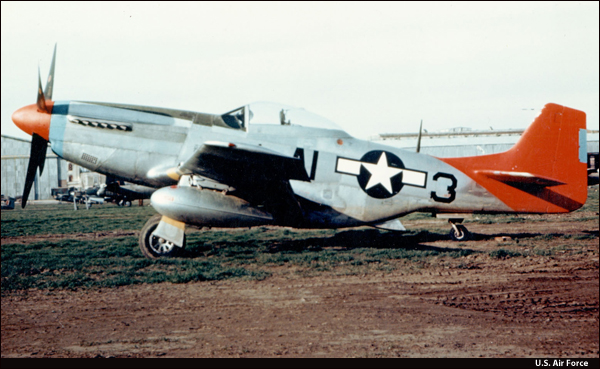
as the “Red-Tails.” (Photo: U.S. Air Force)
The Red Tails flew four different airplanes during the war: the P-40 (Warhawk), P-39 (Airacobra), P-47 (Thunderbolt) and P-51 (Mustang). Harold really enjoyed flying the P-51.
“Flying the P-51 was just plain fun. On my first flight in the P-51, I performed every aerobatic maneuver I knew; I really wrung the aircraft out. After a couple more flights, I was fully prepared to fly my first combat mission. Of course, I didn’t know everything about the aircraft on my first combat mission, because I had only had about five hours of flying time in the P-51. However, as I gained more flying time, becoming more knowledgeable and comfortable in the P-51, it became abundantly clear to me that the P-51 was the finest combat aircraft fighting the war, especially among the conventional aircraft with reciprocating engines (propellers). (Keep Your Airspeed Up, p. 85)
Harold deploys overseas
Two weeks after Harold became a full-fledged Army Air Forces pilot, the Allied D-Day invasion took place along the coast of Normandy, France. After earning his wings, Harold reported to Walterboro, South Carolina for 60 hours of combat fighter training in the P-47. The P-47 was affectionately called “the Jug” because it resembled a milk jug.
In September, Harold took a Liberty Ship from Hampton, Virginia to North Africa. Once in Algeria, he boarded another ship bound for Naples, Italy. He would be flying missions out of Ramitelli Air Field northeast of Naples. The entire trip overseas took more than 50 days.
The D-Day invasion had been successful. Allied troops were pushing Nazi infantry soldiers, the Wehrmacht, back into Germany from the west. And Soviet Union troops were pushing the Wehrmacht back into Germany from the east. In the skies, Allied bombers and fighters were continuing their missions to defeat the German Air Force, the Luftwaffe. Allied bombers were also destroying war infrastructure on the ground in Germany. Airports, refineries, ammunition storage sites, and railroads were primary targets. While their main task was to protect Allied bombers, the Red Tails also engaged the enemy and conducted missions to disable locomotives and trains on the ground.
Harold is taken Prisoner of War (POW)
On March 14, 1945, the Red Tails were flying a special mission to target trains. It was Harold’s 30th mission. As they were returning to base in their P-51s after a successful mission, they noticed one large locomotive still intact. Harold had ammunition left so he said he would get it. As he strafed the train, the locomotive blew up directly under him. Debris hit and disabled his plane. He had no choice but to turn the plane over and bail out.
He knew he would land in enemy territory. But he thought he could get to Russian lines if he could evade capture. Russia was an ally. However, after landing in knee-deep in snow in the Alps, his plan quickly ended. Two skiers with rifles took him to a village. Thirty-five very angry people began yelling at him in German. He didn’t understand German but knew they intended to kill him.
Harold said he began talking to himself to figure out what to do. As they were taking him to a tree to hang him, a local constable intervened. The constable aimed his rifle at the crowd. Harold and the constable backed into a tavern and barricaded the door. At midnight, the constable took him to a neighboring village. Harold was now a Prisoner of War (POW) in German hands. He was 20 years old.
He was interrogated in Nuremberg. After a few weeks, he and thousands of other POWs were told they would be walking 80 miles to Moosburg, Germany. George Iles, Harold’s good friend and Tuskegee 44-E classmate, was a POW there. Harold was shocked to see George who had crashed two weeks before Harold. Harold thought George had made it to Switzerland.
For the walk to Moosburg, German guards divided about 10,000 POWs into groups of 200. Each group had one or two guards. One day while at a farm, George and Harold picked dandelions and cooked the greens. Other soldiers could not believe they were eating weeds but they knew how to cook them. The key is to take off the yellow flower before cooking, Harold said.
With his baby face, Harold was chosen to barter with local residents to exchange cigarettes for food. Harold kept a journal while walking. He noted the towns he passed through and the food he would eat when he was no longer a POW. On April 12, 1945 while they were walking, they learned President Roosevelt had died. They arrived in Moosburg on April 18, 1945.
Gen. George Patton liberates thousands of POWs at Moosburg
On April 29, 1945, General George S. Patton and his 14th Armored Division liberated their POW camp. American tanks knocked down barbed-wire fences. Then Gen. Patton addressed thousands of American POWs from the hood of his jeep.
Harold just happened to be standing close enough to see Patton’s arrival. He vividly recalls the scene.
“Then Patton came roaring in. He was a big man, about six feet, two inches tall, a real warrior, a real soldier. Patton knew that there was a big prison camp in Moosburg and he loved publicity, so when he came into the camp, his jeep was spotless. Somewhere out there along those dirty roads his staff had managed to find enough water to clean and shine that jeep. He was in tan breeches and knee-high cavalry boots, and wore two pistols on his sides. His suit looked like it was just freshly pressed and he had those four stars across his helmet.” (Keep Your Airspeed Up, p. 150)
Patton talked for about five minutes and then said he was on his way to Berlin to get Hitler. The following day Hitler committed suicide. On May 8, 1945, Germany surrendered. WWII in Europe was over.
Harold returns home
Harold returned to Fort Snelling on June 28, 1945, where he and seven other POWs from Minnesota were awarded the Purple Heart. He spent 60 days at home in Minneapolis on leave and then reported back for actifve duty.
He was not yet 21 years old.
“I have often been asked if I had any idea at that time, when I had just returned from the war, what my legacy as a Tuskegee Airman would be. The answer is ‘No.’ After all, I started the process of entering the military at seventeen and came home at twenty. A legacy was the last thing on my mind. I never thought for one second that I was doing something wonderful, that our successes would have the impact that they did. Only years later I realized our actions impacted what eventually happened back here.” (Keep Your Airspeed Up, p. 159)
Harold retired from the U.S. Air Force at the rank of lieutenant colonel on May 31, 1965 with about 6,500 hours of flying time.
In 2012, George Lucas produced a movie about the Tuskegee Airmen. Red Tails (PG-13) stars Cuba Gooding Jr. and Terrence Howard.
REVIEW QUESTIONS
1. During what years did World War II take place?
2. When and where was Harold Brown born?
3. What is the part of speech and meaning of “pursued” and “pursuit?”
4. Where is Tuskegee?
5. What rank did Harold achieve when he passed pilot training and earned his wings?
6. Why did Harold have to parachute out of his plane on his 30th mission in Italy?
INQUIRY QUESTIONS
1. Why did many people tell Harold when he was young that he could never be a military pilot?
2. Why did Harold have confidence that he would be able to become a military pilot?
3. What did Harold do so he was ready when the U.S. Army Air Forces began accepting Black aviation cadets?
4. Why did pilots who crashed during combat missions in Europe want to get to land controlled by Russia or to Switzerland?
5. As the first Black pilots in the U.S. Army, what was the impact of the Tuskegee Airmen on the military and on society in general?