

June 14, 2021 – “Long live the King” or “Long live the Queen” are phrases often shouted by crowds at events in countries governed by a monarchy, a form of government in which governance is passed down from generation to generation within one family. In 1758, Carl Linnaeus (1707-1778), the father of modern taxonomy, classified an orange and black butterfly in the genus, Papilio, and informally named the beautiful insect the “monarch” after King William III of England (1650-1702), a monarch who was also known as William of Orange. Today the monarch butterfly is scientifically known as Danaus plexippus.
Carl Linnaeus (1707-1778)
While the story of how the monarch butterfly was named could be a legend, it makes sense. Linnaeus was a famous scientist in the 18th century who first published his classification system, called binomial (two names) taxonomy, in 1735 in his book, Systema Naturae. He published many editions over the years and eventually created scientific names (taxonomy) for thousands of plants and animals. He identified specific plants and animals in a hierarchy (genus and species) based on similar characteristics.
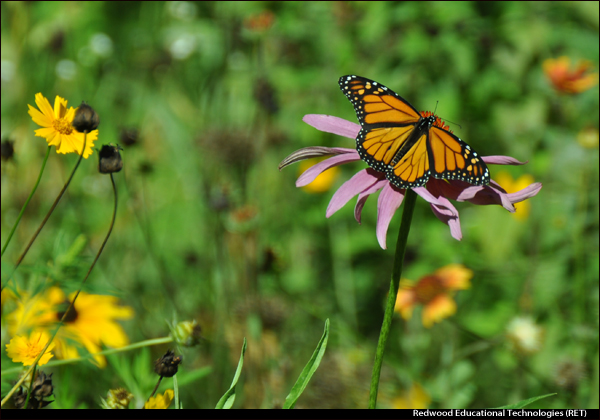
In his book’s 1758 edition, Linnaeus added the monarch butterfly. After his death in 1778, other scientists expanded upon his work. His system is still used today although now scientists can determine plant and animal DNA sequences so living things are classified based on similar DNA sequences.
In 1780, the monarch butterfly was placed in the genus, Danaus and its species was named plexippus so its formal scientific name is Danaus plexippus. For all binomial taxonomy, the genus is capitalized while the species is not. Both names are underlined or placed in italics to easily identify the formal scientific name.
Monarchs migrate
The monarch butterfly is unique in that the species migrates during spring and fall. Two distinct populations in the United States migrate to different locations in the winter. The eastern population of monarchs migrates south to central Mexico where millions of monarchs can be found in trees. The western population of monarchs migrates to the shores of central and southern California to spend the winter there.
During the past 20 years, the number of monarchs has been declining. The U.S. Fish and Wildlife Service (USFWS) and many other agencies have launched a campaign to “Save the Monarch” by providing habitat – milkweed plants. Female monarchs lay their eggs on milkweed plants where the eggs develop into beautiful caterpillars that eat a lot of milkweed! This is the larva. As the caterpillar grows it sheds its exoskeleton. The process is called molting.
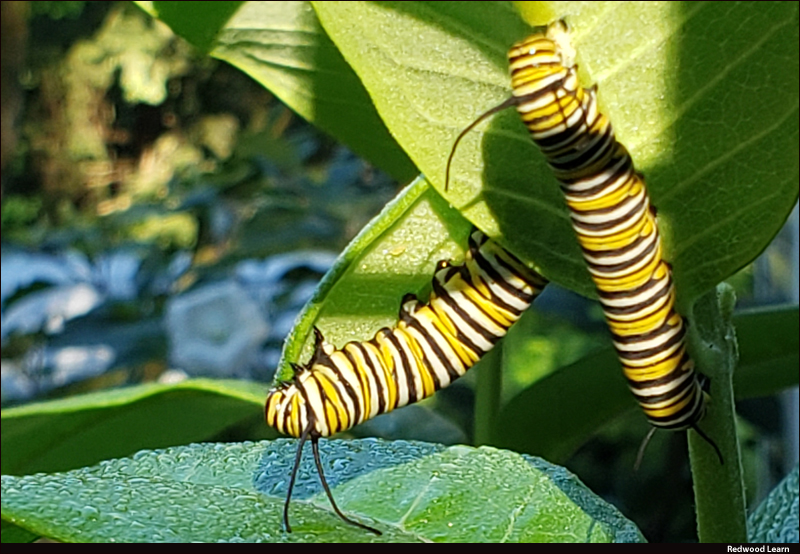
After the caterpillar stage, a chrysalis, a tiny sac, forms. This stage is called its “pupa” stage. Without its exoskeleton, the tiny sac hangs upside down. The monarch’s iconic orange and black wings form and after 8-10 days, it’s ready to fly.
Monarchs are very important because butterflies are pollinators. Many insects are pollinators. Pollinators spread pollen to pollinate fruit and vegetable plants and trees. Not all fruits and vegetables require pollination but many do. It’s estimated up to 70 percent of fruits and vegetables require pollinators.
After studying the decline of the monarch population, in December 2020, the USFWS issued a report saying that listing the monarch as an endangered species was warranted but would not be done because there were other species more important to protect.
“We conducted an intensive, thorough review using a rigorous, transparent science-based process and found that the monarch meets listing criteria under the Endangered Species Act. However, before we can propose listing, we must focus resources on our higher-priority listing actions,” Aurelia Skipwith, USFWS director, said in a Dec. 15, 2020 press release. “While this work goes on, we are committed to our ongoing efforts with partners to conserve the monarch and its habitat at the local, regional and national levels. Our conservation goal is to improve monarch populations, and we encourage everyone to join the effort.”
Long live Danaus plexippus, the monarch butterfly!
REVIEW QUESTIONS
1. What is the formal scientific name for the monarch butterfly?
2. Who named the monarch?
3. Where do the two distinct minarch populations migrate during the winter?
4. What are the four stages of monarch development?
5. What is a monarch’s habitat?
INQUIRY QUESTIONS
1. What would happen if many species of pollinators decline in significant numbers?
2. How can people help save the monarch butterfly?
3. Why is protecting the monarch butterfly an important international issue?
4. In the links, study the migration map. Do monarchs migrate to and from your state?