

Feb. 2, 2023 – As the nation honors Black History Month, take time to study the life of Dr. Martin Luther King, Jr., the ‘Father of the Civil Rights Movement.’ Along with Rosa Parks, the ‘Mother of the Civil Rights Movement,’ these two courageous Americans changed the course of history. Their lives are as relevant today as they were in the middle of the 20th century. Many people still quote from Dr. King’s 1963 ‘I Have a Dream’ speech in which he called for his children to be judged not by the color of their skin but by the content of their character.
Redwood Learn 2021 article on Dr. King
Jan. 18, 2021 – The nation pauses today to honor the life and legacy of Dr. Martin Luther King, Jr, the ‘Father of the Civil Rights Movement.’ It’s a federal holiday first celebrated in 1986 following a law Congress passed in 1983 and signed by then President Ronald Reagan. Martin Luther King, Jr. was born on Jan. 15, 1929 in Atlanta, Georgia. In 2011, the Martin Luther King, Jr. Memorial, operated by the National Park Service, opened on the National Mall near the Lincoln Memorial.
Redwood Learn 2018 Visit to the MLK Memorial
As a teenager during World War II (1939-1945), Martin Luther King, Jr. entered Morehouse College early since so many young men in college enlisted or were drafted into the military. At the age of 19, he graduated from Morehouse College with a Bachelor of Arts in Sociology. He then entered the Crozer Theological Seminary in Pennsylvania and earned a Divinity degree in 1951. He continued his education at Boston University where he began studying for his doctorate in theology. He graduated in 1955, a pivotal year in the civil rights movement.
As an adolescent and young adult, the injustices of Jim Crows laws in the South that allowed racial discrimination infuriated him.
Martin Luther King, Jr. (1929-1968) meets Rosa Parks (1913-2005)
In August 1954 before finishing his degree at Boston University, he traveled to Montgomery, Alabama to speak at a NAACP meeting about the Brown v.Board of Education of Topeka Supreme Court decision. Rosa Parks was at the meeting. She was mesmerized with his eloquence and command of the subject. The Supreme Court had issued the decision on May 17, 1954. The decision made it unconstitutional to segregate schools based on race.
King earned his doctorate in 1955. On Dec. 1, 1955, Rosa boarded Montgomery City Bus #2857 after work. She was a seamstress at a local department store. When ordered to give her seat to a white passenger, she politely refused. She was sitting in the assigned seats for Black riders at the back of the bus. She was arrested, paid a fine and released. In later years, Rosa reflected that at that moment, she was tired of the discrimination. It was time to take a stand by sitting in her seat.
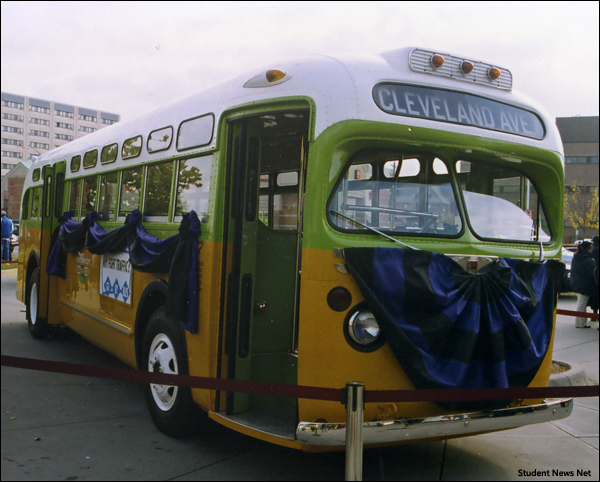
African American history in Detroit for one of Rosa’s memorial services. She died on Oct. 24, 2005.
(Photo: Redwood Learn in 2005 in Detroit)
Dr. King came to Montgomery to support Rosa and the Black communtiy. They started a Bus Boycott in protest. The boycott lasted more than one year. In February 1956, a case was filed (Browder v. Gayle) in the U.S. District Court in Alabama that claimed a violation of the equal protection clause of the 14th Amendment because buses in Montgomery were segregated solely based on race. Gayle was the mayor of Montgomery and Browder was a Black bus rider. The District Court ruled against the city.
On Nov. 13, 1956, the U.S. Supreme Court upheld the decision. It was a violation of the U.S. Constitution to segregate city buses based on race. When the ruling was enforced on Dec. 20, 1956, the Bus Boycott ended.
But the struggle for civil rights continued. Rosa and her husband moved to Detroit in 1957 because of threats against their lives. Dr. King continued his civil rights advocacy and in 1959, became co-pastor of Ebenezer Baptist Church in Atlanta with his father. He held that position until his death in 1968.
March on Washington for Jobs and Freedom
On Aug. 28. 1963, Dr. King participated in the March on Washington for Jobs and Freedom. About 250,000 people came to the National Mall to hear a series of speakers. From the steps of the Lincoln Memorial. Dr. King delivered a speech that is now one of the most famous speeches in American history. His ‘I Have A Dream’ speech called the nation to fulfill the promise made in the Declaration of Independence that “all men are created equal.”
Dr. King said he was there to hand in a promissory note long overdue. In 1776, the Declaration of Independence made a promise and in 1863, President Lincoln had freed the slaves. But 100 years later in 1963, promises of equality were unfulfilled, Dr. King said. He said part of his dream for America was that his children would be judged not by the color of their skin but by the content of their character.
On Nov. 22, 1963, President John F. Kennedy was assassinated. Dr. King then worked with President Lyndon Johnson to advocate for passage of the 1964 Civil Rights Act. President Johnson signed it into law on July 2, 1964. In 1965, Congress passed and President Johnson signed the Voting Rights Act.

(Photo: LBJ Library/Yoichi Okamoto)
On April 4, 1968, Dr. King was assassinated in Memphis, Tennessee where he had gone to help sanitation workers who were on strike for better working conditions.
In 1983, Congress passed and President Ronald Reagan signed a bill that made third Monday in January, beginning in 1986, a day to honor Dr. King.
Dr. King is known as the ‘Father of the Civil Rights Movement’ and Rosa Parks is known as the ‘Mother of the Civil Rights Movement.’
REVIEW QUESTIONS
1. Why did Martin Luther King, Jr. attend college early?
2. What academic degrees did Martin Luther King, Jr. earn?
3. When did Dr. King first meet Rosa Parks? What was the occasion?
4. What was the Supreme Court decision that made it unconstitutional to segregate schools based on race?
5. What court decision made is unconstitutional to segregate people on city buses?
6. What did Dr. King say at the March on Washington for Jobs and Freedom?
7. What two laws were passed by Congress and signed by President Johnson regarding civil rights?
INQUIRY QUESTIONS
1. Why do you think Dr.King became such a powerful and effective advocate for civil rights in the 1950s and 1960s?
2. Why did Rosa Parks become such a powerful and effective advocate for civil rights in the 1950s and beyond?
3. Listen to and read Dr. King’s ‘I Have A Dream’ speech through the link in the right column above. Write a summary.
4. Why were the years from 1954-1956 so important for the civil rights movement?