

Jan. 7, 2023 – Find Hutchinson, Kansas on a map and mark it for a future visit. There visitors can tour two unique and fantastic museums. One is hundreds of feet underground in a salt mine. And the other museum tells the story of rockets and outer space. But the foundation for both can be found in chemical elements. At Strataca, the salt mine, the properties of sodium and chlorine are easily explained simply by walking in the mine and looking at the walls. At Cosmos, the space museum, the explosive nature of hydrogen is evident as the dawn of the rocket age that propelled humans into outer space is featured.
This article focuses on sodium and chlorine as salt in the salt mine. To read about hydrogen and its role providing heat and light for planet Earth from the Sun, read Redwood Learn’s Here Comes the Sun – Hydrogen and Helium.
Below is Redwood Learn’s 2020 story about the salt mine based on a 2013 visit.
Nov. 1, 2020 – Don’t worry about running out of salt anytime soon. The United States has at least a 2,500-year supply of the chemical compound that shakes its way to top billions of snacks each year and melts winter ice on roads. That salt supply is located deep underground along a vein that runs from Missouri to Kansas to New Mexico.
The only place the public can descend into the vein is in Hutchinson, Kansas at Strataca, an underground salt museum. The museum is located within an active salt mine owned by the Hutchinson Salt Mine Company. Yearly, about 500,000 tons of salt are mined by the company. The salt is purchased primarily by cities and states to de-ice roads in the winter.
2013 Strataca tour
Redwood Learn toured Strataca in 2013. It’s an out-of-bounds, awesome museum experience 650-feet underground. Hardhats are required. Rescue breathing devices are mandatory gear to be carried at all times but have never been needed. Fear of depths is overcome by 9-foot ceilings, ample lights, and informative, interesting displays. The climate is constantly dry and about 68 degrees Fahrenheit. It’s a bit scary being so deep in the ground but it’s fascinating being surrounded by salt.
Ralph Hackler, a retiree, led the tour. “I was looking for something to keep me off the streets and I did one better. I got a job under the streets,” Ralph said as he smiled.
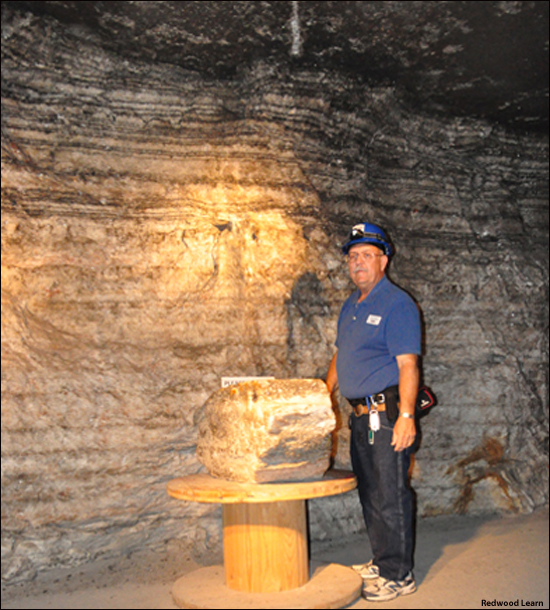
salt and a chunk of salt. (Photo: Redwood Learn)
Ralph explained that salt was formed during the Permian Period, which ended about 250 million years ago. What is now Kansas was part of a super-continent known as “Pangaea.” Pangaea was located close to the equator and covered by a salty sea. As continents moved apart and water evaporated, a layer of salt was left deep in the ground. Eighty feet of seawater needs to evaporate to make one foot of salt.
The salt deposit that forms the salt “vein” located under Hutchinson is about 400-feet deep. At the location of the museum 650-feet underground, salt is found 300-feet above and 80-feet below. The area chosen to mine is comprised of about 95 percent salt.
In 1959 as the Cold War was really heating up, the Underground Vaults and Storage Company leased space from the salt mine to store valuable materials. The mine’s dry air and constant temperature as well as the safety of being 650-feet underground made it an ideal storage location. Today there are 88 rooms filled with all types of valuables. Many are from Hollywood, including a Batman costume worn by George Clooney and the Superman costume from the 2006 “Superman Returns” movie.

(Photo: Redwood Learn)
Visitors can board a tram to tour the salt mine. At one point, flashlights are turned off so visitors experience total darkness.
It’s a good thing sodium and chloride are best friends forever. And it’s a great thing there is an ample supply of the chemical compound that is used daily in millions of kitchens!
REVIEW QUESTIONS
1. Where is the large salt “vein” in the United States?
2. When was the salt deposited there?
3. How many years of a salt supply does the United States have?
4. How deep in the ground (in feet) is the Strataca Underground Salt Museum?
INQUIRY QUESTIONS
1. Why is a salt mine the perfect place to store items with high value, such as movie costumes?
2. Why are sodium and chlorine BFF – Best Friends Forever?