

STORY SNAPSHOT
1. In August 2020, NASA tested the new Dragon spacecraft that will ferry astronauts back and forth to the International Space Station and then to the Moon in 2024. The test was successful.
2. The International Space Station orbits the Earth about 220 miles above Earth. It takes about 90 minutes for one orbit. The Space Station travels about 17,000 miles per hour (mph) and orbits the Earth about 15.5 times per day.
3. On Nov. 15, 2020, four astronauts launched from Kennedy Space Center in Florida for the Crew-1 Mission on board a Dragon spacecraft named Resilience.
4. Resilience successfully docked at the International Space Station at 11:01 p.m. EST on Monday, Nov. 16, 2020.
5. Three astronauts are from NASA and one from the Japan Aerospace Exploration Agency (JAXA).
6. The Crew-1 astronauts will spend six months at the Space Station conducting research in microgravity before returning to Earth.
STORY by Judith Stanford Miller, Redwood Learn editor
Nov. 17, 2020 – Four astronauts aboard the Dragon spacecraft, named Resilience, arrived at the International Space Station last night and at 11:01 p.m. EST, successfully docked to the space laboratory that is orbiting about 220 miles above Earth. It’s traveling about 17,000 miles per hour (mph) and orbits the Earth once every 90 minutes.
It’s the first mission in the commercial crew rotation that will lead the United States back to the Moon and then on to a manned mission to Mars. In August 2020, two NASA astronauts tested the Dragon spacecraft by traveling to the International Space Station. They returned to Earth in the spacecraft after splashing down in the Pacific Ocean. The U.S. Navy retrieved the space capsule with the astronauts on board.
Space Shuttle
For those who watched the space shuttle missions in the 1980s through 2011, the scene inside the Dragon spacecraft looks very different and very futuristic. The shuttle dashboard with an array of knobs, switches and dials, state-of-the-art 1990s technology, is gone.
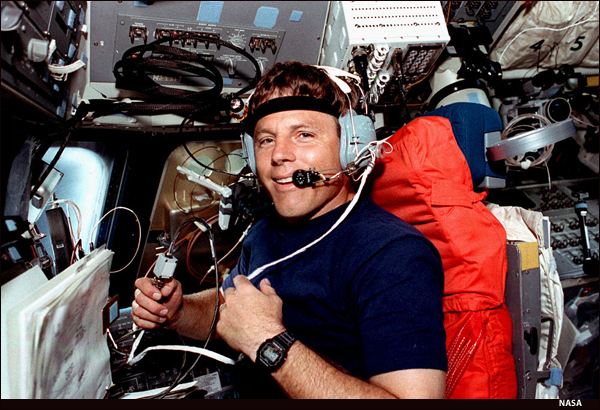
Experiment II (SAREX-II) while sitting at the pilot’s station on the forward flight deck. Oswald is talking to amateur radio operators on Earth via the SAREX equipment. SAREX cables and the interface module freefloat in front of Oswald.
(Photo: NASA)
Instead, Dragon’s dashboard is a series of large computer screens similar to the scene in many offices today. It’s futuristic but the future is definitely here!
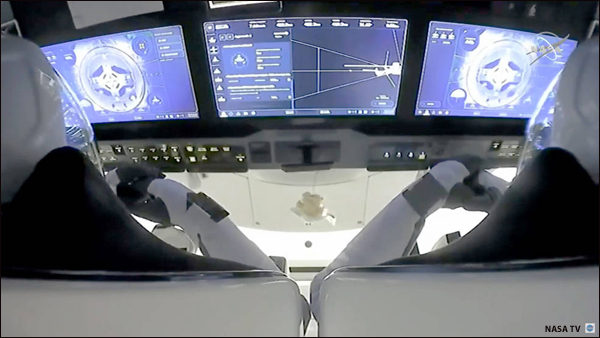
International Space Station on Nov. 16, 2020. (Photo; NASA TV )
Crew-1 Mission
The Crew-1 mission is being led by Commander Mike Hopkins. Victor Glover is the pilot. The two of them – and a lot of computer power – guided the spacecraft for the successful docking.
Also on board are NASA astronaut Shannon Walker and Japan Aerospace Exploration Agency (JAXA) astronaut Soichi Noguchi.
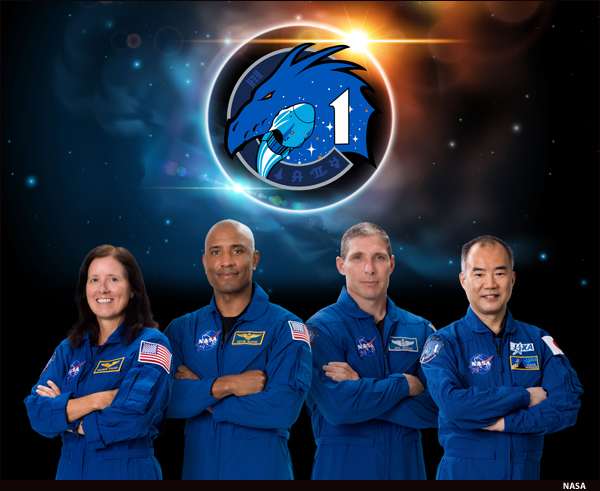
On Thursday, Nov. 19, the four astronauts who are beginning the first crew rotation mission on the space station will join Expedition 64 Flight Engineer Kate Rubins of NASA to answer questions in a news conference from the space station. It will air live at 9:55 a.m. on NASA Television.
Firsts
This mission has several “Firsts.” Those include
1. The first flight of the NASA-certified commercial system designed for crew transportation, which moves the system from development into regular flights
2. The first international crew of four to launch on an American commercial spacecraft
3. The first time the space station’s long duration expedition crew size will increase from six to seven crew members, which will add to the crew time available for research
4. The first time the Federal Aviation Administration (FAA) has licensed a human orbital spaceflight launch.
Research
The six-month mission will be focused on research. One study includes chips with tissue that mimics the structure and function of human organs. The goal is to understand the role of microgravity on human health and diseases. Those findings will then translate into three areas of focus: 1) improving human health on Earth 2) growing radishes in different types of light and soils as part of ongoing efforts to produce food in space, and 3) testing a new system to remove heat from NASA’s next generation spacesuit, according to NASA.
Review Questions
1. At what altitude is the International Space Station orbiting the Earth?
2. How long will the Resilience crew spend at the Space Station?
3. What research will the Resilience crew be conducting on the Space Station?
EXTRA! EXTRA! (Links and Inquiry Questions)
1. Track the Space Station (NASA)
5. Through link #1 above, where is the International Space Station now?
6. From stats in the story, how many miles does the Space Station travel in one day?
7. Choose one of the three astronauts above. Read their bio. Write a summary of their aviation career, including what do you think prepared them to be selected for NASA’s elite corps of astronauts.
8. Compare the photo of the shuttle from 1993 and the current Dragon dashboard. Discuss how technology is a tool that led to amazing feats (accomplishments) both in 1993 and today.
9. Why do you think NASA and SpaceX named the Dragon spacecraft Resilience? Write a short essay.